A LOVE SUPREME

I am now blogging at a new blog: erdman31.com

If you post comments here at Theos Project, please know that I will respond and engage your thoughts in a timely manner.

Thursday, November 16, 2006

Name that face


The prize goes to whoever can guess the circumstances surrounding this expression.

Monday, November 13, 2006

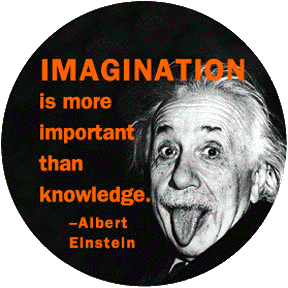
Einstein for a Monday morning

It is a miracle that curiosity survives formal education.


The important thing is not to stop questioning. Curiosity has its own reason for existing. One cannot help but be in awe when he contemplates the mysteries of eternity, of life, of the marvelous structure of reality. It is enough if one tries merely to comprehend a little of this mystery every day. Never lose a holy curiosity.


A few Einstein quotes I pulled from quotationspage.com:
http://www.quotationspage.com/quotes/Albert_Einstein/
Einstein on Wikipedia:
http://en.wikipedia.org/wiki/Albert_Einstein


The most beautiful thing we can experience is the mysterious. It is the source of all true art and science.

Saturday, November 11, 2006

Thursday, November 09, 2006

How To Read A Text

The question: Should we teach people how to interpret the Bible?

Is interpretation something that we teach? I would like to suggest here that it is more a matter of practice: something that is learned.

The question that this introduces, of course, is whether or not there is one, right method for interpreting the Bible. That is, do we posses The Biblical Interpretation Method that is the key to unlocking all of the good stuff in the Bible.

Many would say that they do, in fact, have such a method or at least that they've got something really close that just may need a little tweaking here and there. As such, in certain circles (particularly in seminaries) we develop a "How to Read the Bible" manual. This may include an emphasis on "historical-grammatical" interpretation, or a focus on discerning the "intent of the author," or even methods for determining the "literal" meaning of the text over and above "figurative" senses.

In regards to the literal rendering we might determine certain ways in which metaphors operate: if the text indicates metaphorical or figurative language then the interpretation should be metaphorical. However, in the absence of such an indication all Scripture should be read literally.

This happens not merely in regards to Scriptural interpretation, either. There are many articles and books written on metaphors: how to detect a metaphor, how to classify a metaphor, and how to determine what classification of metaphor we are dealing with. An example is the distinction between a "dead" or a "live" metaphor. A dead metaphor is one that is used so often that its metaphorical value is virtually zero. It functions more literally than metaphorically. In English an example would be "as dead as a doornail." This is a figure of speech that, although it acts metaphorically, it is so familiar that it functions in a literal sense. A live metaphor is one that captures a sense of ambiguity while still generating a description....

The point is that we ponder language and develop methods for interpretation. The same thing holds true of Scripture. We ponder the text and develop methods of interpretation.

No argument at this point. This is a good thing. We all develop interpretive frameworks, that is, we all naturally develop methods for discerning meaning. This is true of speaking as well as writing. When we are children we learn language, and when we go to another country with a foreign language we must learn that language. So, our minds naturally learn what people mean when they say words and/or when they say them in a certain way and when they use certain body language. We have build-in mechanisms that help us learn how to understand each other. The same thing holds true in interpreting a text. Let us call this our interpretive framework: The method we use to interpret a text.

But our interpretive framework is not always something we are conscious of. Most of us just naturally learn how to interpret a language by interacting with people. Or we just learn how to interpret a text as we engage in reading. Consider that it may take years to learn a language in a classroom, but only months to pick up the same understanding by plunging one's self into a culture and engaging people in conversation.
Interpretive frameworks evolve and change. This is not to advocate "relativism" or any such boogeyman it is simply to note how we operate. For example, when we interact with different people and encounter different language our frameworks of interpretation change. Our minds naturally react to changes we encounter in our language. Not only this, but as we interact with the same people who use the same types of language that they have always used we learn to interpret them better. We might notice subtle moves that they make and over time we learn that these subtle things mean something: A husband, for example, might shift his weight right to make himself comfortable before telling a lie to his wife, and the wife learns to determine this meaning over time.
So, our frameworks evolve and change. Same thing when we interpret texts. Our frameworks naturally evolve and change as we encounter texts. We study the same texts and get a better feel for what they are all about. We study new texts and our frameworks continue to change.
Here is the point: It is a danger to solidify the framework and set it in stone. And yet this is often what happens in hermeneutics classes across the country in conservative seminaries. There is a "one way" to look at the text. This stunts the personal growth of your own interpretive framework and suspends the ability to see a text from a different angle or from a new perspective. Not that growth is impossible - as I say, it is simply stunted and slowed.
One of the keys for truly engaging the word of God in a local church community is dialogue. As we engage the Word from varying perspectives it accelerates and expands our frameworks. We see the text from a different side or from a different angle. This diversity challenges preconceived notions, while also simultaneously reinforcing orthodoxy and interpretations that are essential for defining the faith. Ultimately, dialogue amongst the faithful works as a mechanism of safeguard as well as a process for personal and community growth.

One might charge that opening up dialogue is dangerous because it risks a relativistic free-fall: A process where everyone's perspective is equally valid and hence the truth of the text is compromised by the multiplicity of perspectives. Ultimately, it is this line of thinking that has led to many conservatives "fixing" forever and ever a "How To Read The Bible" manual. But surely this is an overreaction. Perhaps in some contexts this is necessary, but certainly not on a widespread scale. The church should never create a hermeneutic that is motivated by fear. This is a purely defensive posture that weakens the mind and heart of the church. In fact, I believe it is the hermeneutic of fear that has led to anti-intellectualism in the church in a far greater way than relativism, Liberalism, or any external threat to the church. A body of believers that is motivated to question their faith internally stands the strongest chance of rebutting the threats to orthodoxy that come externally.

In regards to a hermeneutics of fear we might also ask, "From whence comes your How-To-Read-A-Text manual?" In other words, how did we come about with this correct body of interpretive guidelines and rules? Was it dropped from the sky? Did God inspire an interpretive method? No at all. Rather, it was developed by people like you and I. They may have been much smarter than you and I, but they remain fallible. Furthermore, they came about by these rules inductively: They studies many texts and looked for patterns of similarity. And they, like the rest of us, got a sense of "How To Read A Text". But if this is the case, then the sacred methods that we declare infallible are really only the product of scholars who thought they were a good idea. This is not to say that they should not be take seriously - because we must respect the efforts of the wise. Rather, it is simply to say that no method is infallible. No method escapes the finite touch of mere mortals who are subject to error.

In the end interpretation is a lively exchange, a dynamic dialogue that sharpens the faithful and transforms the community. For this reason it may not even be advisable to teach methods of interpretation - except amongst those who are really interested in it. Better to simply allow people to engage the text. As they engage their interpretative frameworks will evolve and grow and they will, quite naturally, apply their learning to other areas of Scripture. It is in this context that the church can renew a dynamic study of the Word and revitalize an appreciation for the authority of the canonical text. True dialogue will accomplish more in this regard than a thousand sermons because preaching tells us what we should be, but personal encounters make us new.
Rumsfeld is gone


Darn.....I liked Rummy.....I know, I know, go ahead and take your shots, but I liked his macho style.

Monday, November 06, 2006

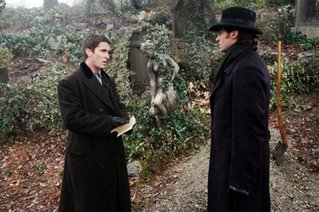
The Prestige (2006)


Saw it last night at the theater. Very good movie. Directed by Christopher Nolan, who also directed Batman Begins and Memento - both movies that I thoroughly enjoyed. In The Prestige Nolan teams up with Christian Bale (Batman Begins) once again and the result is that Nolan brings out the darkness of Batman and combines it with the twists and turns of Memento. The result is very intriguing. Nolan keeps you thinking, though, but not so much that you can't enjoy the artistry of the movie.

I highly recommend it.

Oh, and Michael Caine is superb, per the usual!


One Sentence Plot Line:
Two rival magicians battle each other in a feud that goes back to the death of one of their wives which results in a battle of minds that is both intriguing and also a matter of life and death.

Give the movie a spin and let me know what you think.

Language getting personal, Words of life

Read this:

askljfekwouenf,nwerfhksdfguuirgivn.,rgklja

Ok, you probably can’t and that’s ok. But if you are familiar with the English language you immediately recognize the characters and symbols as letters and punctuation marks in our alphabet.

Now let’s take those letters and arrange them into groups that we can recognize:

A closet is a small room.

Ok, that’s a bit better. Although we recognized the marks in our first example we needed to arrange them into something sensible. Our language has evolved over time such that when we read the sentence “A closet is a small room” it carries a meaning with it – we can recognize it as something intelligible.

But even in the second example something is lacking, so let me throw another example at you:

There is an intruder in your closet!

Ok, now it is personal, isn’t it? I am no longer speculating about a closet or a small room, or what it means for a closet to be a closet. Instead I am speaking of your closet. And your closet has an intruder. If I were to communicate this to you directly you might have several alarming thoughts race through your mind:
Is this intruder going to harm me? What do they want? Should I call the police or get myself a weapon? And how does Jonathan know I have an intruder in my closet, anyway?!?

Perhaps it is the last question that would be most applicable, right? On what basis do I know there is an intruder in your closet? For me to warn you of an intruder in your closet I must have some sort of personalized connection with you. Then meaning of my language then is interwoven with the personal nature of my experience. In other words, my statement (“There is an intruder in your closet!”) only has meaning if I have some sort of actual, personal knowledge that there is, in fact, an intruder in your closet. This is the personal nature of language. Language gets personal.
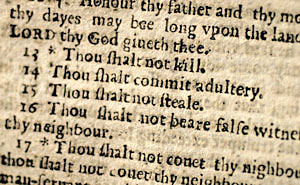
This is the human (all too human) aspect of language that seems to be necessary for Revelation to be personally meaningful. God could have stopped revealing when he inscribed with his own hand upon the stone tablets of Moses upon Mount Sinai. Or he could have continued to reveal in this manner: A direct dictation that left little doubt of its connection with the Creator. This Revelation would have been meaningful, of course, and I suppose to an extent it would be personally meaningful. However, when someone has a shared experience with us it speaks to us on a deeper level. For example, only those who have experienced an intruder in their closet can truly relate with each other. Otherwise it is just speculation and conjecture.

So, rather than speaking language through his own hand God spoke through the faith experiences of human beings. Shared experiences mixed with authoritative commands mixed with intense emotional output mixed with historical narrative mixed with wisdom, and on and on….the Revelation reaches through human souls to touch human souls. Through human words to affect human worlds. Through human lives to bring us new birth.

Thursday, November 02, 2006

Apologetics and Evangelism: A Dialogical Manifesto


I remember a year or so ago I attended an apologetic conference up in Chicago at which Ravi Zachariah was speaking. At this same conference was an old preacher who also spoke. For the life of me I’m not sure why he was scheduled to speak with these high profile speakers, but speak he did – and it was painful for me. He rattled on for what seemed like an eternity ridiculing the irrationality of the so-called “postmodern” person. His presentation was a mixture of reductio ad absurdum appeals combined with jokes and strawmen arguments all designed to demonstrate the absurdity of anyone who would subscribe to these “postmodern” ideas.

I certainly took issue with his incorrect portrayal of the “postmodern.” He was quite obviously unfamiliar with primary texts of the usual postmodern suspects: Derrida, Barthes, Foucault, etc., etc. But this for me was only a minor irritation. The main problem that I had with the old preacher on that day was his obvious superiority complex.

The old preacher was clearly in business to prove the dominance of the church over and against other ideas and rivals. As I will show later, there is nothing wrong with stating one’s position and believing that one has a superior view. But his was a superiority with a focus on dominance and defeat. There were several things that were implicit in his tone, ideas, and presentation:
1 - The church must prove its superiority to the world.
2 - Having proved herself superior the church is now worthy of the world's attention.

The preacher obviously was working under a model of apologetics and evangelism that sought to seek-and-destroy. And in so doing he gains a hearing from the world who will recognize the superiority of his position. And an added bonus, of course is that he will simultaneously assure all of his devoted Christian listeners that their faith is sure because their worldview is so much better than anyone else’s.

One needs to do little to show that this model will gain no hearing with those who are among the “postmodern.” It is speaking a language of alienation, which will only confirm the suspicions of the postmodern who believes that religion is merely another form of domination and control.

The old preacher’s model gains no hearing and garners no respect in the public square.

Furthermore, I do not think it is all together consistent with biblical teaching. Where did we get the idea that the church was to be a tool for domination? Jesus exhorted his disciples to teach obedience and make disciples. Interestingly, Jesus seems more interested in long-term dedication than in quick converts who are only impressed by the superiority of the Christian worldview.

But there is the other end of the spectrum: The antithesis of the old preacher. In reaction to the superiority complex presented above many that we might call post-evangelicals suggest a model of conversation with the world. There is, as far as I can gather, a willingness to surrender or suspend one’s beliefs or positions in order to enter into conversation with those of differing religions. One might even hear talk of “learning” from these other perspectives and world views. In this way the model of dominance and superiority is turned on its head. The point is not to convert or conquer but to engage and to converse. This model serves as an important corrective to the old preacher and those of similar ilk because it opens up the public square to give Christianity a hearing and provides an opportunity to make the case for faith.

However, the question that I have for this conversational engagement has to do with identity. Does Christian faith lose its identity by seeking to blend itself in with conversation and “learn” from other worldviews? The problem I have is the suspension of belief and what I see as a suspension of controversial positions for sake of conversation.

But this raises the important issue: Must the church have a superiority complex (like the old preacher) in order to establish an identity?

Now, my problem with suspending our beliefs is not to suggest that we must always come out with guns-a-blazin.’ A must not always put their worst (or most controversial) foot forward when presenting the faith. The problem is not in a temporary suspension of controversy, but in a permanent suspension of tension.

As such, I present two reasons why tension and controversy is crucial for Christian dialogue:

First, the controversial claims of Christianity are at the heart of the faith. Like it or not Christ made the claim that he was the only way to God. The John 14 passage is perhaps the most famous of these in which Jesus claimed to be “the way, the truth and the life.” And, just so as to make sure there was no confusion as to whether or not there were other “ways” or other “truths” or other “lifes” outside of himself he added that “no one comes to the Father but by me.”

To claim the Christ of revealed Scripture is to claim an exclusive Christ. A Jesus who demands not only personal allegiance from his followers, but also demands that all persons in every place acknowledge his pre-eminence. The heart of Christian faith is the lostness of everyone who rejects Christ. Jesus claimed that he was the only true connection between a broken human race and a God who seeks to mend that brokenness.

Deny the Christ-connection to God and you deny the heart of Christian faith and biblical revelation.

But besides being essential to Christian faith there is another reason to embrace the tensions of the faith: It is the only way to have real and genuine dialogue.


I’m not sure it is possible to have dialogue apart from position statements – you believe this and I believe that. Perhaps you believe the Bears are the dominant team in professional football (the American “football”) and I believe that the best case is for the Indianapolis Colts. But what kind of fun can we have if we suspend our beliefs because there is tension? Can we ever engage in true dialogue about the better team if we deny our heart-felt belief in the superiority of our team?

True dialogue means openness. It means opening one’s belief up to analysis and attack. It is a passive willingness to be examined, and it is an active engagement with that examination. It begins a process of exchange that centers on truth and discovery. This is what opens to door for issues to come to the surface that might otherwise have remained hidden. (For example, I might not have realized how superior the statistics were for the Bears’ defense over and above the Colts, and likewise you might not have truly considered the dominance of the Colts in the past 4 years.)

Real learning happens when we are open, and this openness requires an uncompromising statement of our own position on an issue regardless of how controversial it may be. Openness has two sides: Openness to learn and openness to teach. The learning comes as we are critiqued and analyzed. The teaching comes when we present our views and the reasons that we hold them. Real dialogue never compromises or completely suspends identity, but at the same time it opens itself up for examination.

Call this my Dialogical Manifesto.
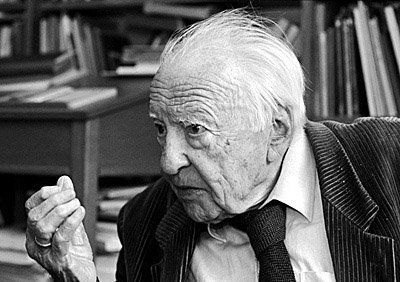
Hans-Georg Gadamer
The dialogical man, himself

The Hen and the Capitalist

I recently had a discussion with a friend of mine who is giving her workers (about 10 of them) one more week to produce the necessary quotas or she will cut their heads off.
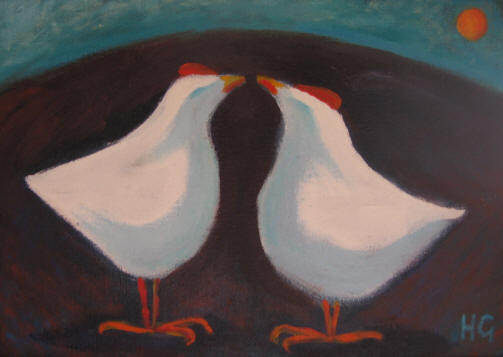
The workers, of course, are her laying hens. The hens are only producing 1-2 eggs per day, which is far below the bosses expectation. The hens will be executed if their production doesn't pick up.

I suggested therapy for the chickens - that perhaps something traumatic has triggered a depression of some sort and the result is an inability to find motivation. However, my friend is unmoved...Obviously she is a demanding Capitalist whose sole object is profit....




Wednesday, November 01, 2006

Did God write the Bible?

In the past God spoke to our forefathers through the prophets in many portions and in many ways.

Hebrews 1:1


One question that has been rolling around in my mind for a while is whether or not it is appropriate to call God an "author" of Scripture. After all, God didn't actually put the pen to the paper. Furthermore, Scripture never calls God an "author." There is talk of inspiration, etc., but I don't believe the term "author" is ever used.

This passage in Hebrews opens up a labyrinth of hermeneutical possibilities. On the one hand it clearly points out the common sense notion that we have of the multiple authors and voices in Scripture. The written Bible is a composition of a variety of expressions and perspectives. It is diverse and far from monolithic.

In some cases God revealed a specific word through a prophet, presumably in a verbal way. These words were then repeated to the nation(s), and later written down as a testimony of God's spoken Word. In other passages God simply seems to be revealing through a poetic expression via the Psalms. Or he may use the historical account as a means of speaking Scripture. And, in a very rare case, God writes directly upon the stone and reveals his decalogue to Moses on Mount Sinai.

There is incredible diversity in Scripture, which raises the question of how God remains the "author" of all of these "various ways" spoken of in Hebrews 1:1. To call God an "author" in this sense seems vague and uninformative. And yet if God is actually speaking in all of these diverse scenarios then there is a sense in which each and every text is a creation of God's authority.

So, perhaps God did not speak in one, particular way. Perhaps the process of God's inspiritation of Scripture is as diverse as the Scriptures themselves.

Forgive(n)

What does it mean to truly forgive a person?

Forgiveness is the one issue that it seems every person must deal with, and must deal with on a regular basis – even if we don’t consciously think about it.

On the one hand, we are all wronged, hurt, abused, and violated. And this happens on a regular basis. The world we live in is an endless cycle of abused trust, hurt, pain and suffering. This has been the process ever since Cain invited Abel out into the field under false pretext and attacked and killed him. This is the earliest biblical example of a violation of human rights, and ever since then no one has escaped being caught up in this cycle of abuse.

The fact that we can relate to this so well is due to the fact that we notice this abuse most clearly when we are personally wronged. We notice abuses most clearly and lucidly when they happen to us. At least that seems to be the normal process. It is one thing to hear of people’s property being confiscated by the government in some other country – that may bother me a bit – but if the government were to confiscate my property it is at that point that I am passionate enough to take up arms!

The point is that the farther away someone is from me the less passionate I am for the cause of justice. If someone in my immediate family is being wrongly treated then I feel the weight of the injustice and the wrongness of the situation. Let it happen to someone I don’t know in a country I’ve never heard of, and, as a general rule, it will not affect me. The only exception to this, as far as I can see, is when someone unknown suffers the same injustice as I have suffered. A victim of a rape will have instant sympathy when he or she hears of another rape victim, because deep down they instinctively know what it is to suffer in that way.

This brings us back around to choice of forgiveness. What does it look like to truly forgive in situations in which we suffer injustice. These things may happen on a large scale as we mentioned in some of the examples above, or it may be on a smaller scale – perhaps my electrical company has unfairly overcharged me, or the auto mechanic is taking advantage of my helpless situation and making me pay twice as much as I otherwise would have.

Whatever the scenario we are each faced with the choice of how we will handle these various situations. The natural inclination, I think, is to hold on to the pain and embrace resentment. I say this is the “natural” inclination simply because this is my observation of others and myself.

When I am in a situation where I suffer price-gauging at the hands of that dastardly auto mechanic my first reaction is to justify the resentment that I feel. I may play back in my mind the wrongness of his actions from a variety of angles: “He was wrong for doing this and for that….and he really had no cause to do such and such….and, of course, the look on his face told the whole story of how ridiculous and depraved this character really is….”

If I am really resentful, then I will dialogue with a friend or acquaintance about the seedy auto mechanic, reviewing all of his antics and garnering support for my resentment. The point is this: I want to justify and hold on to the resentment I feel.

On the other hand, we are faced with the issue of forgiveness when we, ourselves, commit the wrongdoing: When we become the abusers. The tables turn, and I am no longer the victim but the perpetrator of the wrong.

When the role is reversed I want to justify myself, but in this situation I want to justify myself against any need for forgiveness. I refuse to accept forgiveness because there is no basis for it. If I am the seedy auto mechanic, then there are a host of reasons why I was perfectly justified in overcharging. In fact, when I look at all the “facts” of the situation it may just be the case that I wasn’t overcharging at all! It’s economics, after all, isn’t it? Supply and demand. My customer doesn’t have to use my services….There are a myriad of ways to justify myself if I am the seedy auto mechanic.



The above cycle is the cycle of sin. The undeniable reality of abuse and wrongdoing that infects the creation by a perpetuation of evil and the justification of that evil. And, furthermore, the justification for withholding forgiveness. It is, of course, the brokenness of the world, which we all must partake in. It becomes so natural that for us to exist in this darkness is like the fish in water – it is a part of our element. And because it is a part of our element we must justify ourselves. We justify resentment and we justify our abuses.

This justification is natural. And, to the surprise of many (Christians included) it is modeled in the biblical text. Psalm 137 is an example of dealing with abuse and resentment. It reveals the necessity of facing pain and the importance of understanding the depths of resentment. It shows us that in some cases resentment is a necessary path to the ultimate goal of forgiveness.
But this begs the question of where forgiveness falls on this whole wicked scheme of things. Forgiveness, I say, never occurs until the fullness of wrongdoing is understood. I can’t forgive until I understand that I am not obligated to forgive. Justice is on my side! I have been wronged and would be perfectly justified in holding it against this person for all the rest of my days. Especially if that seedy auto mechanic never expresses the least bit of remorse.

I can never forgive until I understand that I am not obligated to forgive. I can never forgive until I can look all of my pain in the face – for all its ugliness – and then, after all of that still say, “Father forgive them, they do not know what they do.” True forgiveness is truly understanding resentment and justice. But understanding resentment and justice is still not true forgiveness.

Friday, October 27, 2006

Weekend God-Poll

Since we are in the election season and polls and public opinion are so crucial, I thought I might take a quick God-poll.

Would your opinion of God change if, in a booming voice from the heavens He declared:
"I am not real. I am just an idea, a symbol, an object of faith and worship. I only exist as thoughts and feelings in your mind."