A LOVE SUPREME

I am now blogging at a new blog: erdman31.com

If you post comments here at Theos Project, please know that I will respond and engage your thoughts in a timely manner.

Saturday, November 28, 2009

Einstein's God

I have been reading through the Walter Isaacson biography of Albert Einstein. I am about halfway through, and I have enjoyed the read. It has helped me familiarize myself a bit better with the scientific transition from a Newtonian universe to an Einsteinian (if we can call it that) universe. For those interested in Einstein or the scientific advances of his time, I highly recommend this biography.

I thought you might appreciate a few of Einstein's thoughts on God and religion.

"Science without religion is lame.
Religion without science is blind."

"At the heart of this realism was an almost religious, or perhaps childlike, awe at the way all of our sense perceptions--the random sights and sounds that we experience every minute--fit into patterns, follow rules, and make sense.....'The very fact that the totality of our sense experiences is such that, by means of thinking, it can be put in order, this fact is one that leaves us in awe,' he wrote."

Even though Einstein helped lead the way in quantum theory, he balked at the results of a chaotic universe. Einstein was ever and always a determinist, believing that the universe behaved according to a pattern that was set. He differed with many of his fellow religious Jews who tended to believe in free will. Einstein's determinism also put him at odds with his colleague and friend Niels Bohr; together they engaged many lively discussions on the topic of the random nature of quantum theory versus the determinism and predictability that was Einstein's dogma. In this context, Einstein would say, "God does not play dice." Bohr would respond in frustration: "Einstein, stop telling God what to do!"

Monday, November 23, 2009

Evangelistic


Galatians 1:8 But even if we or an angel from heaven should proclaim to you a gospel contrary to what we proclaimed to you, let that one be accursed!

1:9 As we have said before, so now I repeat, if anyone proclaims to you a gospel contrary to what you received, let that one be accursed!

1:11 For I want you to know, brothers and sisters,that the gospel that was proclaimed by me is not of human origin;

1:15-16 But when God, who had set me apart before I was born and called me through his grace, was pleased to reveal his Son to me, so that I might proclaim him among the Gentiles, I did not confer with any human being,

1:23 they only heard it said, "The one who formerly was persecuting us is now proclaiming the faith he once tried to destroy." (NRSV)

"What is the gospel? The Greek euangelion has come into English by way of Latin and French as evangel (cf. German Evangelium, French evangile). The more common gospel derives from the Old English godspel "good talk," and--like the popular phrase good news--is based on the etymology of the Greek word....

"The gospel of Christ is accordingly an abbreviation that points to the content of the gospel, which has already been alluded to in Paul's additions to the opening (vv. 1b, 4). Thus the gospel, which in his [Paul's] view is perverted by the troublemakers in Galatia, is the proclamation that God has created salvation in the event of Jesus' death and resurrection....For Paul this understanding has consequences in regard to the law and circumcision, which he will then discuss in the following chapters....The foundation of his [Paul's] argumentation is primarily the content of the gospel, the Christology. Subordinated to it are the Scriptures (for him, only the Old Testament) and the history of the gospel in Paul's own history from his conversion before Damascus to his activity in Galatia." (Dieter Lührmann, p. 12-13, Galatians 1992)

Given enough time and energy, I hope to blog a bit through the book of Galatians....we shall see....in any event, something strikes my fancy as I read through these opening verses in Galatians. Paul is an evangelist. The Greek words that we translate as "gospel" and "proclaim" (or "preach") are very similar, euangelion and euangelizo, respectively. Why this is interesting is the link between proclamation and content, the relation between the way in which one is proclaiming the gospel and the gospel that is being proclaimed....and....of course.....that makes me think of my own prior background as an evangelical in the U.S.

From my experience in evangelical circles there has been a very rapid decline in enthusiasm for evangelism. I think that this creates a bit of an evangelical crisis. Evangelism, as it has been defined in the last fifty years or so, basically reduces to proselytizing: convince others that Christianity (or "a relationship with Jesus/God" as the contemporary language goes) is the religion of choice. As I said, from my experience, the younger set is kind of losing its steam for this kind of approach. So, most people really don't engage in proselytizing, at least not in a direct person-to-person mode.

To address this crisis of evangelism, the evangelism of choice these days is marketing manipulation. (Yes, I am negatively predisposed!) Contemporary evangelism has taken the form of media to the masses. Evangelical film, literature, and staged church performances attempt to persuade the nonbeliever of his or her need to become a believer. This seems more subtle to today's evangelical--rather than "preach" to people and put them off with a direct confrontation (as they did in the good 'ole days), the contemporary evangelical prefers the subtle, nonthreatening methods of modern media. In my opinion, however, it is simply a manipulation tool like all other manipulation tools in today's media age. This is evangelicalism in the digital age, evangelism as advertising, manipulation, and marketing.

My observation at this point is that we need to evaluate the link between the gospel message (euangelion) and the "proclamation" (euangelizo). Simply put, the reason that so many evangelicals cringe at the thought of direct evangelism is that the message itself is so threatening, uncomfortable, and just plain awkward. Things can get a bit uncomfortable when you mention to people, "Uh, there's this place called hell that you are going to....."
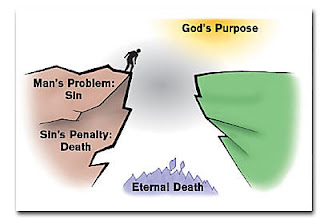
The received gospel that most evangelicals inherited is this: Everyone is going to hell because each individual (no matter who they are or what they have done) is a sinner, thankfully Jesus died for your sins and rose again, you need to now confess you are a sinner and have faith in Jesus so that you are no longer a hell-bound sinner. In most evangelistic presentations (and this is a crucial point), the emphasis is on the gap between God and human beings. Each individual is responsible for "repenting," "having faith," feeling really really guilty and bad, or responding in some way ("having faith," perhaps?) that will close this gap. Some gospel tracts illustrate this by showing a cross that bridges the gap. Your job is to walk across this cross that bridges the great divide.

Most "biblical evidence" for this received gospel is based on cutting and pasting verses together from various parts of the Bible. This is no accident, because the above gospel is simply not the gospel that Paul teaches. (It is Paul, incidentally, who develops the most thorough New Testament theology of the gospel.) There are verses that one can find to support this gospel, but then again, one can mix and match verses to come to most any conclusion.

Paul's actual gospel spends scant little time (if any) expounding on hell or the sinfulness of individuals. It's there, no doubt, in the classic texts like Romans 1 and Ephesians 2. But the point of such discussions, as I read them, is not to condemn people as much as it is to contrast two approaches to life: one view of life where one is consumed with themselves and ultimately destroyed by their own ego-obsessions, the other view of life is a life lived by faith, walking with the spirit in love (agape) and self-less-ness. It's not really about saving your own self from hell. Actually, this sort of spiritual narcissism ("how can I keep myself from burning in the next life?") is one of the problems.

Paul's gospel is much more progressive. Radically progressive, actually. It is about a "new creation" (2 Corinthians 5:17). It is about "reconciling all things" (Colossians 1:20). Furthermore, contrary to popular evangelistic efforts, the goal is not to elicit a spiritual experience of rebirth. Rather, the goal is to simply recognize that the fact that any person can join the happy band of the redeemed. For Paul, whatever happened on the cross took care of the gulf between God and man. So, living as a part of this merry band of new creationists is to simply recognize that you are already on the other side. The reconciliation has already taken place. There is nothing that a person needs to "do" to cross the bridge. That's been taken care of, which is why Paul spends most of his time talking about what it means to live out this new life, rather than talking about what we have to do to "get in" and "be saved."

So, maybe the reason why so many are losing interest in evangelism is because they never really had a very good gospel. And perhaps I can even be a bit more radical here: perhaps evangelism isn't about proselytizing. Perhaps it isn't about winning converts or "getting people saved." Maybe the great proclamation is simply to announce that there is no gulf between God and humanity, that God's focus for the world is reconciliation and peace, that personal and global transformation start with a gift of grace that is available to all, and that we need as many people as possible to get on board with this positive mission of reconciliation.

It's no wonder evangelism is petering out, or being relegated, impersonally, to mass media proselytizing. It's a dour, powerless gospel. Remember how Paul begins his letter to the Romans? "For I am not ashamed of the gospel, for it is the power of God for the deliverance (soterian) of all who believe." This is a racial inclusivity, not an exclusive who's-in-and-who's-out approach. In Paul's letter to the Galatians power and transformation are also the focus. The life of the spirit produces the fruit of the spirit: love, joy, peace, patience, kindness, goodness, faithfulness, gentleness, and self-control.

Perhaps evangelistic zeal could be rekindled if a gospel was proclaimed that was a bit more in line with the radical vision of Paul. What is the radical vision? Simply that there is nothing to do, nothing to do to cross a bridge or any such nonesense. Grace is the ultimate do-nothing, which paradoxically transforms. There is nothing to do except to believe in a new creation and live by this faith. This gospel must be beyond formulas, beyond definition, and even beyond words. This is so because the gospel is about grace, which is ineffable.

So, as I read the first verses of Galatians and as I reflect on the state of evangelism today, the pivotal question that arises, the absolutely crucial question for a Christian, is this: have we got the right Gospel?

Sunday, November 22, 2009

Stars

Ralph Waldo Emerson once asked what we would do if the stars only came out once every thousand years. No one would sleep that night, of course. The world would become religious overnight. We would be ecstatic, delirious, made rapturous by the glory of God. Instead the stars come out every night, and we watch television. -Paul Hawken

Monday, November 16, 2009

Life

"The most fatal thing of all is to satisfy a want which is not yet felt, so that without waiting till the want is present, one anticipates it, likely also uses stimulants to bring about something which is supposed to be a want, and then satisfies it. And this is shocking! And yet this is what they do in the religious sphere, whereby they really are cheating men out of what constitutes the significance of life, and helping people to waste life."
Soren Kierkegaard
The Attack Upon "Christendom"

This is an interesting commentary. My first instinct was to think of our hyper consumeristic society, a culture where advertising and marketing anticipates and generates our desires for corporate goods and services. But it is intriguing that Kierkegaard applies this idea to "the religious sphere."

As an existentialist, Kierkegaard believes in wrestling through our own inner worlds. Faith is a personal journey, not something that can be scripted by the church. Too often religion cheats us out of the significance of faith by averting us away from the struggle. This reminds me of what King David said: I will not sacrifice to my God burnt offerings that cost me nothing.

The idea of sacrificing for anything is an obsolete notion in the U.S. Here we have our lives and faith scripted out. Marketing and advertising lines it all up for us: a meaningful life = these goods and services. Just sign the dotted line. Work a job that doesn't inspire you, or even one that you hate. Sign the dotted line. Take out as much credit as you can.

The system is artificial, though. And when it collapses, perhaps then we can struggle again. Then we can have a meaningful faith, something we have to really struggle for.

Monday, November 09, 2009

Gilead: Introduction

The next novel in my Human Narrative Project is Gilead by Marilynn Robinson. Gilead is a significant novel. After writing her first novel in 1980, the very successful Housekeeping, Marilynn Robinson did not publish her second novel until 2004. It was met with resounding critical success, winning the 2005 Pulitzer Prize for fiction.

Twenty-four years after her first novel,Housekeeping, Marilynne Robinson returns with an intimate tale of three generations from the Civil War to the twentieth century: a story about fathers and sons and the spiritual battles that still rage at America's heart. Writing in the tradition of Emily Dickinson and Walt Whitman, Marilynne Robinson's beautiful, spare, and spiritual prose allows "even the faithless reader to feel the possibility of transcendent order" (Slate). In the luminous and unforgettable voice of Congregationalist minister John Ames, Gilead reveals the human condition and the often unbearable beauty of an ordinary life. From the Publisher's website

The novel is a deeply spiritual work, written from the perspective of a minister, John Ames, who has descended from a family of clergyman. It is Ames's letter to his young son, written in from the fullness of his heart and mind; Ames is suffering from a terminal disease. He reflects on the depth of his spirituality and theology, interacting with scriptures and theologians. Yet despite the overt religious musings, Gilead has won the respect of the critical world, both secular and sacred. Somehow, the honest and personal way in which John Ames reflects on his life and occupation is disarming to both the skeptic and to the religious fundamentalist. The novel is also of historical and sociological interest, examining the ways in which religion and faith have effected the formation of American society and the individuals who have historically shared very deep spiritual convictions and dogmas.

"At a moment in cultural history dominated by the shallow, the superficial, the quick fix, Marilynne Robinson is a miraculous anomaly: a writer who thoughtfully, carefully, and tenaciously explores some of the deepest questions confronting the human species. . . . Poignant, absorbing, lyrical...Robinson manages to convey the miracle of existence itself."--Merle Rubin, Los Angeles Times Book Review

''Gilead'' is much concerned with fathers and sons, and with God the father and his son. The book's narrator returns again and again to the parable of the prodigal son -- the son who returned to his father and was forgiven, but did not deserve forgiveness. Ames's life has lately been irradiated by his unexpected marriage and by the gift of his little son, and he consoles himself that although he won't see him grow up, he will be reunited with him in heaven: ''I imagine your child self finding me in heaven and jumping into my arms, and there is a great joy in the thought.''

Gradually, Robinson's novel teaches us how to read it, suggests how we might slow down to walk at its own processional pace, and how we might learn to coddle its many fine details. Nowadays, when so many writers are acclaimed as great stylists, it's hard to make anyone notice when you praise a writer's prose. There is, however, something remarkable about the writing in ''Gilead.'' It's not just a matter of writing well, although Robinson demonstrates that talent on every page: the description of the one-eyed grandfather, who ''could make me feel as though he had poked me with a stick, just by looking at me,'' or one of a cat held by Ames's little son, eager to escape, its ears flattened back and its tail twitching and its eyes ''patiently furious.'' It isn't just the care with which Robinson can relax the style to a Midwestern colloquialism: ''But one afternoon a storm came up and a gust of wind hit the henhouse and lifted the roof right off, and hens came flying out, sucked after it, I suppose, and also just acting like hens.'' (How deceptively easy that little coda is -- ''and also just acting like hens'' -- but how much it conveys.)

Robinson's words have a spiritual force that's very rare in contemporary fiction -- what Ames means when he refers to ''grace as a sort of ecstatic fire that takes things down to essentials.''
From the excellent review in the New York Times, Acts of Devotion, by James Woods

I plan on having my review posted on December 1.

Enjoy the read!

[The review is now posted: Gilead]

Thursday, November 05, 2009

Being still

Be still and know that I am God

Since last spring, I have implemented a regular practice of meditation and silent prayer. The main focus of this practice is to simply be silent and still.

Silence and stillness is a tricky thing. In stillness and silence, any number of thoughts and feelings might arise. Ideally, when one is meditating, all attention is focussed on breath. This is also called "mindfulness." When one is mindful of nothing but one's own breathing, then there is a deep sense of stillness, silence, and peace.

This is the ideal.

As I have engage in a regular practice of stillness, I quite naturally want to become better or more skilled at the practice. I want there to be less noise from my heart and mind. I want to enter into that sense of peace.

Many spiritual practices are like this. We tend to look at "spiritual growth" in terms of mastery: are we mastering the our particular moral or spiritual skill/art/practice? We tend to be critics of ourselves, measuring ourselves by some standard that we hope to achieve.

James Finley, a spiritual teacher, says that good meditative practices tend to be messy. This is a wise approach.

The act of stillness, silent prayer, or meditation is not about achieving some state of peace. It is not in any way about becoming better. It is an end in itself. It is a practice of grace. As a practice of grace, the point is not to "grow" or "achieve." The point is to just be. Just as I am.

When grace is the foundation, then we can embrace everything that we experience during stillness. If we feel distracted, then we can become aware of our distracted heart/mind in a gracious way. If we are deeply hurt by others, then we can become aware of our pain in a gracious way. If our soul is restless, then we can become aware of our feeling of restlessness in a gracious way. If our minds are busy and excited, then we can become aware of this positive buzz in a gracious way.

This practice of grace is a "letting be." Whoever we are is okay. We become grounded in something that is deeper than merely the rising and falling of our thoughts and feelings. Whatever it is that we are "grounded in" is mysterious. It isn't something that we can define or ever capture. From the perspective of the Christian tradition, this is the sense of "Be still and know that I am God."

By letting ourselves be, just as we are, we become less clingy to life. We become less controlling of life. We realize how much is out of our control, and how necessary it is to extend grace in the same way that we have experienced grace.

The practice of stillness, silence, and meditation is about honestly engaging the feelings and thoughts that channel through us. We develop awareness of who we are and surrender ourselves into grace.

Sunday, November 01, 2009

To Kill A Mockingbird

I think there's just one kind of folks. Folks. ~Scout, Chapter 23


Friends, this is the inaugural post of my Top 100 novel reviews: The Human Narrative Project. We are kicking off with a very special novel, To Kill a Mockingbird. I thoroughly enjoyed my reading--it was a joyful and deeply thoughtful read.

Haper Lee's To Kill a Mockingbird is a classic in American literature. It was an instant classic when it was published in 1960. Lee began her project as a collection of stories loosely based on her childhood in Monroeville, Alabama in the 1930s. After devoting herself to writing for four years, her novel became both a charming story of southern life and also a complicated description of southern racism, classism, justice, and equality. Published in 1960, we are only months away from Mockingbird's 50th anniversary, making this a timely moment to review and reflect on the novel's significance.

Part 1 of the novel centers on the life of Jean Louise Finch, aka "Scout." Scout navigates through the world of Macomb, Alabama. She is a lively and rambunctious young girl who prefers fighting and wearing pants to serving tea and wearing dresses. Scout, her brother Jem, and neighbor Dill combine their energy and imaginations to embark on wonderful childhood adventures

We also get to know Scout's father, Atticus Finch. He is a quiet and principled man, gentle and gracious to all. Atticus is the moral hero of the novel; he is bookish and works as a lawyer in town. Atticus's primary motto is that everyone should try to understand each other, to walk around in the other person's skin for a while and understand things from their perspective. This is also one of the primary messages of the novel. In the context of a southern society that is stepped in racism and classism, Atticus believes that all people have dignity and honor, just because of who they are.

Part 1 of the novel sets the background for Part 2. In Part 1, we primarily sympathize with the town. The novel is fun, humorous, and very entertaining. The narrative is engaging and humorous; Harper Lee is a remarkable story teller. But the divides between the races and various classes of Macomb also emerge in Part 1, and in Part 2, we primarily grapple with injustice, irrational prejudice, and what it might mean to do the right thing in this context.

Part 2 focuses on the trial of Tom Robinson. Tom is a black man accused of rape by Mayella Ewell. Her father, Bob Ewell, claims that he arrived at the house in time to witness the rape. The narrative leads us to believe that the accusation is false: Mayella tried to seduce Tom, Tom tried to leave the scene, and Bob Ewell came to the house in time to view this cultural taboo. In a rage, Bob Ewell beats his daughter, and they together agree to accuse Tom of rape. Atticus does his best to defend Tom, planting seeds of doubt in the jury's mind by exposing holes in the testimonies of Mayella and Bob and presenting circumstantial evidence that makes it unlikely that Tom could have caused Mayella's injuries. Despite Atticus's reasonable and honorable defense, the jury does not acquit. Although Tom is as innocent as a Mockingbird, the jury finds him guilty. Atticus whispers to Tom, gathers his coat and hat, and takes his "lonely walk down the aisle."

The children (Scout, Jem, and Dill) watch the trial from the segregated black section of the courtroom. They take it very hard. Scout and Jem cannot understand why someone who is innocent could be convicted. Tom Robinson gives up. While in the prisonyard, he tries to escape and is shot.

The novel ends with a rather odd sequence of events. Bob Ewell swears revenge on Atticus for humiliating he and Mayella in the trial. One night, while Jem and Scout are walking home in the dark of night, he attacks them. Boo Radley, the reclusive neighbor, stabs and kills Bob Ewell. The Sheriff and Atticus discuss the matter. The Sheriff is adamant: It would be a sin to expose Boo Radley to public scrutiny. The conclusion is that Bob Ewell fell on his own knife.

What strikes me in a profound way about Mockingbird is the way we are forced to engage the tension between our ideals (the way things should be) and the reality of living in a broken system. How does one respond to a system that seems to refuse to budge? Atticus is "looking for racial salvation through hearts and minds." (Malcolm Gladwell, p. 28 of The New Yorker, August 10 & 17, 2009) Atticus appeals to the heart, he lives a life of grace. He refuses even to condemn those who are a part of this broken system. They have blind spots, but they are still people. Everyone is broken. Atticus still choses to live in Macomb, to live honorably and treat all people with dignity and respect. Atticus embodies the words of Ghandi: Be the change you wish to see in the world.

On the other hand, what happens when people reach a breaking point? When they just won't take injustice anymore, and they stand up and fight it to the death?

Or what of those who believe that passively living in Macomb, Alabama is itself a way of allowing the system of injustice and prejudice to continue?

This is a tension that the novel forces us to engage: Do we appeal to the heart? Or take up arms? In fighting injustice, it is often difficult to see whether progress is being made, and it seems almost impossible to understand in the present whether or not we have made the right decision in how we engage the struggle.

Yet for me, the very way in which this question is formed and the flow of the narrative all suggest that this is very much a white novel. The central characters are white. They have the power, they hold all the cards. The black characters are mostly static and helpless: they are at the mercy of whether the whites will do the right things. The narrative never really explores the hearts and minds of any of the black characters, not to the degree that it engages Atticus, Scout, and Jem. That this is a white novel is not really a fault of the novel, but in my opinion it is a crucial point. The Black Power movement (and others) of the 1960s questioned the notion that blacks must wait for whites to give them permission to be empowered. This notion itself is one of the most fundamental ideas that must change before equal power and rights can be assumed. As a novel and narrative, Mockingbird operates within the paradigm that the whites must empower the blacks. The positive side of this is to force whites to take responsibility for injustice.

There is a certain element of deconstruction at work here. By this, I mean that there is a certain paradox and contradiction at work. On the one hand, those in power must seek to empower those who are treated unjustly. On the other hand, the very idea that one can "empower" another human being is mistaken: we all are empowered and must take power. In the very act of empowering, we are assuming an inappropriate stance towards others who are in fact our equals.

Mockingbird also challenged me at a very fundamental level. It is a novel that hits us in the gut. In a broken system, there are no right answers. There are no "correct" solutions. There is not neat and tidy way to wrap things up. Systems of injustice and oppression grow over time, they dehumanize. They create superior classes and races: "us" and "them." As time goes on and on, this brokenness cannot be undone. There is no ideal that will fix things. Sometimes we are idealists, striving for the good. Mostly we are pragmatists, just doing the best we can.

So we keep striving. Something calls us to give ourselves. We try to "walk around in someone else's shoes." But mostly we stumble.

Friday, October 16, 2009

Slaves and Heirs

One of the key distinctions for most versions of Christianity is a stark distinction between "saved" and "unsaved." There are the B.C. days, meaning "before Christ," and there are the "I'm a new creation" days that come after salvation. The salvation experience, then, is a complete ontological change, a drastic transformation from one spiritual state-of-being to another.

This ontological transformation is clearly an important part of the theology of the Apostle Paul. "Behold, all things have become new." Those who are of the faith are "a new creation." The language of the Apostle Paul is clearly aimed at transforming our belief about ourselves, to conceive of ourselves as radically different. Holy. Chosen. Loved.

I have always been a bit suspicious of this stark dichotomy between "believer" and "unbeliever." Common experience shows that "believers" are not quite as perfect as they would like to be, and "unbelievers" are not quite as "depraved" as many Christians would like them to be.

Apart from common experience, though, my recent study of Galatians shows that in the writings of the Apostle Paul, himself, there may be reason to question this dichotomy. I would like to turn your attention to Galatians chapter 4.

In Galatians 4, Paul begins by talking about how an "heir" (kleronomos) is no different from a "slave" (doulos), at least while the heir is still "under age" (nepios). In one sense, the heir is still the "ruler of all," but in another sense the heir is like the slave; this is true, until the time is set for the heir to receive the inheritance and actually assume their position as the ruler and lord.

For Paul, this is an analogy for the Galatians. They were at one time "under the elemental spiritual forces of this world" (hupo ta stoichia tou kosmou). This time period, though, was the time period of being "under age" (nepios). Paul uses this same word, nepios, to describe the situation of the Galatians when they were not yet believers. If the analogy holds, then, it seems that the Galatians, although not yet believers were still heirs. They were just still nepios, they were under aged and had not yet discovered the fullness of who they are.

This passage lead me to consider that the believer/unbeliever dichotomy might not be as sound as many like to believe. Is it possible that those who are living "under the elemental spiritual forces of this world" are simply not yet of age? Not yet come into the fullness of who they are? And if we take this a step further, perhaps wisdom and humility would suggest that none of us have completely arrived in this regard. That we are all coming into our own as heirs. While there may be a specific time at which the "heir" becomes "master" and assumes the control of the inheritance and the position of lord, it is equally true that becoming a wise, discerning, and benevolent is a life-long process. Theologians sometimes speak of this as "already, not-yet."

While a person may have a spiritual conversion experience, this does not yet mean that a person has fully come into their own as a person of faith. In fact, observation often reveals that if someone believes themselves to have "arrived," then this is often indicative of pride and ego-assertiveness. When pride and ego become the dominant sources of motivation in life, then one can actually experience a good deal of personal and spiritual regress. In this sense, making a sharp dichotomy between "believer" (those who have arrived or are farther along) and "unbeliever" (those who still need a bit of work to get on down the road a bit) might be counter productive.

Sunday, October 11, 2009

On surviving without faith

"If you have a particular faith or religion, that is good. But you can survive without it."
The Dalai Lama
From the Vancouver Sun, September 26, 2009

Tuesday, October 06, 2009

The Book

Well, my dear blogging friends, Tamie and I are in the process of a six week road trip. We are primarily camping and visiting friends in the pacific northwest. (You can get trip updates at her blog.)

We very much enjoyed our stay in Minneapolis/St. Paul with a few of Tamie's good friends, Dave and Kacey. The Twin Cities are a wonderful metro area. Of special interest to myself is how much the natural environment is integrated into the city. There are many lakes within the city, the Mississippi River, many trees, and an extensive system of biking/walking trails for alternative commuting. The Twin Cities are definitely an urban area that I could see myself inhabiting.

But to the main point of this blog post, which is to leak a bit of information: I have been working on the beginning phase of thinking through a book. This is my first shot at writing a book, and as such I am excited about the venture. The topic is grace, and the book will be an attempt to weave together many threats: theological writings on grace, philosophical issues, a New Testament exegesis of the Apostle Paul's thoughts on grace, and the implications that grace has for spiritual and psychological transformation.

Much of my personal pilgrimage in recent years has continually come back to the issue of grace. Everything in the lives we live in this world seems to contain conditions, everything has a catch. In philosophical and theological terms, everything is involved in an economy of reciprocity. There is no such thing as a free lunch.

My point is not necessarily to say that this situation (this economy of reciprocity) is wrong. Even Paul (see Romans 4) does not say that the economy of exchange is wrong: the one who works for his wages gets what he works for, nothing more, nothing less. But grace seems to move beyond reciprocity, which creates a problem because we have no reference for a non-reciprocal reception of anything! Normal experience teaches us that there is no gift given that has no strings attached. This is the world we inhabit, this is the perspective that colors the way we view others (and the relationships we cultivate). There is no free lunch.

Protestant Christianity of all stripes carries this idea into their idea of grace, albeit in a way that I consider to be somewhat disingenuous: God gives you the "free" gift of salvation.....therefore....you should should be grateful and do __________. Where many Christians differ is in the way they fill in the blank. But there always seems to be a blank. The result of this is that most Christians carry forward some brand of guilt--guilt for not being good enough or making enough "spiritual progress," moral failings, etc.

But Christianity is not going to be my sole focus. I hope to write a book whose relevance reaches non-Christians and the non-religious. Paul's gospel of grace, after all, was originally aimed at the "uncircumcision," the non-chosen ones. (See Galatians 2 for Paul's own description of his mission.) In its pure form, Paul's gospel of grace seems to have been a quite radical form of non-reciprocity. My hope, then, is to understand how this radical notion of grace might open up dialog between faiths and between those of faith and those without faith.

I want to reimagine what grace might be if we stripped it down bare. What if grace truly became the centrality of theology, doctrine, practice, and spirituality? What if there never were strings attached? Can we even begin to thing this way?

More and more I am realizing that this project is about using language to describe what is beyond and deeper than language. As such, one of the main focuses of this book will be to write what we might call creative theology; that is, using writing ot inspire the imagination, to open up possibilities and new beginnings, not just to close off the topic by presenting the conclusive word on the subject. Grace is to big for that, too deep. I hope that the writing will not merely be the transfer of theoretical information (as important as that is) but rather the kind of language that generates the spiritual and psychological creativity of the reader, leading the reader to both go deeper into herself and at the same time farther beyond herself than she could have envisioned.

Therefore, I look froward in the future to post questions and comments about grace. I am interested in your thoughts and questions on this project.

What about grace is of interest to you? How does grace relate to your experiences?

I think it would be fantastic to generate discussion prior to the writing of a book, so that the book possibly might be something that grows out of conversation and dialog.

You can leave comments here, or email me at erdman31@gmail.com.

Friday, October 02, 2009

Gandhi


"You must not lose faith in humanity. Humanity is an ocean; if a few drops of the ocean are dirty, the ocean does not become dirty."

"What difference does it make to the dead, the orphans and the homeless, whether the mad destruction is wrought under the name of totalitarianism or the holy name of liberty or democracy?"

"I cannot teach you violence, as I do not myself believe in it. I can only teach you not to bow your heads before any one even at the cost of your life."

"It is better to be violent, if there is violence in our hearts, than to put on the cloak of nonviolence to cover impotence."

"Freedom is not worth having if it does not include the freedom to make mistakes."

"Always aim at complete harmony of thought and word and deed. Always aim at purifying your thoughts and everything will be well."

"You must be the change you want to see in the world."

Tuesday, September 29, 2009

To Kill a Mockingbird: Introduction

"Now, 75 years later in an abundant society where people have laptops, cell phones, iPods and minds like empty rooms, I still plod along with books." --Harper Lee

The first novel of our ambitious narrative project (a reading, review, and discussion of 100 novels) will kick off with Harper Lee's 1960 classic, To Kill a Mockingbird. I will post a review on November 1, and this novel will be the topic of discussion for the month. I hope you choose to read along, I look forward to your thoughts. And if you decide to post anything on your blog, send me the link so that I can link to your thoughts. For those of you reading ahead, the novel for December will be Gilead by Marilynne Robinson.

Upon publication, To Kill a Mockingbird became an instant classic. It quickly became a best seller and won the Pulitzer Prize within a few years of publication. In 1999, it was voted "Best Novel of the Century" in a poll by the Library Journal.

Interestingly, this was Harper Lee's only novel. Only a few years after publication, Lee disappeared from public life. Her novel was four years in the making, starting out as a project to write out some of the stories of her childhood. The novel evolved, however, and became a commentary on southern life and racism.

Said Lee, "I never expected any sort of success with 'Mockingbird.' ... I was hoping for a quick and merciful death at the hands of the reviewers but, at the same time, I sort of hoped someone would like it enough to give me encouragement. Public encouragement. I hoped for a little, as I said, but I got rather a whole lot, and in some ways this was just about as frightening as the quick, merciful death I'd expected."

The book is loosely autobiographical, based on stories of Lee's childhood in Monroeville, Alabama in 1936 when she was 10 years old. The father figure and hero attorney Atticus Finch is a loose interpretation of Lee's own father. Another example is Dill, a character in the novel who mirrors Lee's childhood friend and life long collaborator, Truman Capote.

Lee describes her four year writing process as a "long and hopeless period of writing, over and over again." At one point, she threw the manuscript out into the snow, but she was convinced by her agent to go get it and send it in.

The novel's primary strengths are two-fold. First and foremost, Lee is an amazing story teller. She gives amazing descriptions of life in the south, primarily from the perspective of a child. This is a perfect example of the strategy "writing what you know." Although the novel is warm, engaging, and often humorous, the subject matter is racism and scapegoating, so the novel is also dark and gothic. The reader has to engage something very evil about human nature. As such, Mockingbird manages to capture the innocence and simplicity of childhood while never flinching from the dark and disturbing elements of blind, murderous racism. Somehow, the novel is both charming and wrenching, engaging the best and worst of the human condition.

The book was adapted into an Oscar-winning film in 1962 by director Robert Mulligan, with a screenplay by Horton Foote. The lead is played by Gregory Peck, and the film is considered one of the best and most true film adaptations of a novel.

In terms of stylistic elements, I have previously mentioned the remarkable story telling ability of Lee. Along these lines, it is intriguing to discuss voice. The voice of the narrator is primarily that of a child, Scout. But at certain key moments, this child's voice shows a certain reflectiveness and maturing of a much older woman looking back on her experiences. This blending of perspectives is subtle and accomplished with great skill, so it is difficult to notice. However, when reading through, look for the unique way that Haper Lee uses her narration voice: primarily childhood naivete with a smattering of an older and more reflective commentary.

Mockingbird definitely challenges conventional class and race perceptions. One example of the challenge to classism is a scene where Scout is chastised by her father and by the black servant, Calpurnia, for displaying naive classism toward a guest in their home. The challenge to conventional racism is also clear and the primary subject of the novel. One of the primary messages of the novel comes from Atticus who teaches his children not to judge someone else until they have "walked around in their skin."

And yet despite it's obvious uplifting and positive message, I think it would be good to look a bit deeper: does the story telling of the novel display classism, and even racism? For example, who is the hero of the story? A black man or a white man? Which characters receive the most character development, the blacks or whites? (Which characters are static versus dynamic?) The point of such inquiries is not to undercut the importance of the book or negate its positive impact, but simply to deal realistically with the text. For example, as a white man, I find the novel incredibly uplifting, but would I feel the same positive emotions if I were a black woman?

Again, this line of inquiry does not negate the positive contribution of the novel to race and class relations. Clearly the main theme ("walk around in their skin") is a message of respect for others who are different, but is there some sense in which the novel reduces blacks or the poor lower class? Is there some sense in which the ignorant poor whites need to be tolerated and the powerless blacks need to be rescued by the heroic white man? This is a subtlety that I would like to discuss. Do those who are morally enlightened and empowered in a society (like that of the novel) picture themselves as those who give power to the powerless? In this case, I still sense a subtle elitism at work.

And now, I have saved the best for last: the theme of the scapegoat.

Another important theme to look for in the novel is the scapegoat. I will discuss this more in my review, but there is something that I think is deeper in the novel than racism. Look for the way in which Tom becomes a scapegoat for the community, a way in which they are able to handle their differences through the sacrifice of an innocent victim. The sacrifice of the scapegoat becomes a way to discharge the deep anger and hostility of the individuals and the collective community. The scapegoat is innocent. Look for the theme of innocence in the novel and the way in which innocence is represented and often destroyed. "It's a sin to kill a mockingbird" because mockingbirds only sing and give pleasure to those who hear them.

There is much to discuss and I look forward to November.

Happy reading!