A LOVE SUPREME

I am now blogging at a new blog: erdman31.com

If you post comments here at Theos Project, please know that I will respond and engage your thoughts in a timely manner.

Friday, October 27, 2006

Weekend God-Poll

Since we are in the election season and polls and public opinion are so crucial, I thought I might take a quick God-poll.

Would your opinion of God change if, in a booming voice from the heavens He declared:
"I am not real. I am just an idea, a symbol, an object of faith and worship. I only exist as thoughts and feelings in your mind."

Thursday, October 26, 2006

"Headliners", or "How bizarre can human beings actually be?"

Prisoners wed after peephole courtship
ABIDJAN (Reuters) - Two prisoners in an Ivory Coast jail who courted and fell in love through a peephole in an iron door have been released for a few hours to get married, one of their jailers said Friday....

Obedient driver follows orders, crashes car
BERLIN (Reuters) - A German motorist followed the command "Turn right now!" from his navigation system and crashed into a small toilet hut by the side of the road -- about 30 yards before the crossing he was meant to take.
The overly obedient 53-year-old from Freiburg drove his sport utility vehicle off the road onto into a building site, up a stairway and into the small toilet shack, police in the eastern town of Rudolstadt said Sunday.
It caused 2,000 euros ($2,500) worth of damage to the stairway, 100 euros damage to his car, and he was also fined 35 euros.
Earlier this month an 80-year-old motorist also chose to follow his navigation system and ignored a "closed for construction" sign on a Hamburg motorway. He then crashed into a pile of sand but neither he nor his passenger were injured.

Ah, the start of my new life! But first...
BRUSSELS (Reuters) - A man freed from jail in Belgium last Friday allegedly committed eight robberies before being arrested the next day, the national Belga news agency reported.

Fighting spirit saves retiree from attack
BERLIN (Reuters) - A 70-year-old British pensioner, trained in martial arts during his military service, dispatched a gang of four would-be muggers in a late-night attack in Germany...
The man, a native of Birmingham who now lives in Germany, was challenged by three men, demanding money, while a fourth crept up behind him. Recalling his training, the Briton grabbed the first assailant and threw him over his shoulder.
When a second man tried to kick him, the pensioner grabbed his foot and tipped him to the ground. At this point, the three men, thought to be aged between 18 and 25, fled, carrying their injured accomplice with them.
The pensioner, whose name was not immediately available, suffered light abrasions.

Austrian man separates from wife and ring finger
VIENNA (Reuters) - A Viennese man cut off his ring finger and presented the digit, still holding his wedding band, to his ex-wife after an acrimonious divorce, Austrian news agency APA reported Tuesday.
Charged with dangerous harassment and assault for the act, he told a preliminary hearing he did not regret having cut off the finger and had chosen deliberately not to reattach it.
"It was an act of breaking free," the man was quoted as saying. He did not miss his finger, could work well without it and did not plan on getting married again anyway, he said.

Science exam a test of love...
ACCRA (Reuters) - A 30-year-old Ghanaian man could be jailed for up to five years after writing his wife's paper in a science exam, police in the West African country said on Wednesday.

"Sexsomniacs" puzzle medical researchers
LONDON, Oct 25 (Reuters Life!) - Researchers are struggling to understand a rare medical condition where sufferers unknowingly demand, or actually have, sex while asleep, New Scientist magazine reported on Wednesday.
Research into sexsomnia -- making sexual advances toward another person while asleep -- has been hampered as sufferers are so embarrassed by the problem they tend not to own up to it, while doctors do not ask about it.
As yet there is no cure for the condition, which often leads to difficulties in relationships.
"It really bothers me that I can't control it," Lisa Mahoney told the magazine. "It scares me because I don't think it has anything to do with the partner. I don't want this foolish condition to hurt us in the long run."
Most researchers view sexsomnia as a variant of sleepwalking, where sufferers are stuck between sleep and wakefulness, though sexsomniacs tend to stay in bed rather than get up and walk about....

Want to diary your death? Ask online
LONDON, Oct 26 (Reuters Life) - With Halloween looming, 'tis the season to be morbid and people wishing to know their expiry date can indulge in some online trick-or-treating at websites which predict the date of their death.
"I'm sorry, but your time has expired! Have a nice day," says the "sadistic mode" on http://www.deathclock.com.
The site invites visitors to enter their date of birth, smoking habits, height, and weight in exchange for a pop-up ticker which counts down the seconds they have left...

Wednesday, October 25, 2006

Blogoneutics 101

Does "blogging" = "writing"?

Consider the case of writing. We write a text and then send it off to a publisher. The editors at the publishing house send back their recommendations, etc. and through a process of haggling and bartering that rivals even the shrewdest ancient Mesopotamian we arrive at a text that “satisfies” all. So, now the text goes to print.


Once a text is in print it is “out of the hands of the author.” I put that in quotes because it is a major hermeneutical debate as to what exactly it means that at text is “out of the hands of the author.” (Does this mean that the author is no longer important, dead, etc.??) But regardless of where one falls on this debate is unimportant. The important thing is to recognize that, in some way, the text is no longer under the author’s control. It has been cut loose. Let’s call this case “traditional writing.”


But this is not the case of a blogger: He or she can publish and then rewrite at any point. Or, if the blogger prefers not to change the original blog, they can always leave a comment that amends, modifies, or expands the thoughts of the original post. So, there is a sense in which the “text” is never out of the hands of the author.


But what is the blogger’s “text”?


One might be tempted to say that it is the original post – or the post after the blogger has modified it. But this is not entirely the case because any person – be they foolish or wise – can modify the “text” by leaving comments. The text, then, is not just the opening post, it is the post and any comments written. The post, of course, is probably the primary focal point that “controls” the discussion, but this is only a general rule. In many cases two argumentative commenters might inflame one another and begin a series of comments that have absolutely nothing to do with the original post and everything to do with proving which of the two of them is the smart one, which by default will reveal that the other party is, in fact, a fool.


Additionally, it may be that the original post sets the subject matter, but a much more insightful comment is made, which rightfully becomes the focus of the comments that follow. If I were to review a work of Anthony Thiselton, and he were to leave a comment I would gladly defer the focus of my post to Dr. Thiselton. (I would do so even if he were simply to say, “Hello, there. Jolly good post. Good day.”)


So, as we can see, the “text” becomes much more fluid than traditional writing. It can change, and remains a continual work in process up until the time a blogger would close down comments and dies….or just chooses to no longer alter the text. The point is that a blog is fluid and morphs in directions that one cannot quite predict.


And we have not even yet considered the “control” that a blogger has in that he or she can delete comments!


In the end, it seems as though blogging simultaneously connects and disconnects the author in a way that traditional writing cannot do. The text is never severed from the author in the way it is in traditional writing: the blogger can change the post or alter the text by adding a comment. But, at the same time, the text is at the mercy of a countless number of factors because it is open to comment. It is this openness that makes blogging something so unique that to we might not quite be able to call it “writing.” Maybe writing is only a part of what is happening on a blog.


Tuesday, October 24, 2006

Engaging the Needy

Matthew 25

31"When the Son of Man comes in his glory, and all the angels with him, he will sit on his throne in heavenly glory. 32All the nations will be gathered before him, and he will separate the people one from another as a shepherd separates the sheep from the goats. 33He will put the sheep on his right and the goats on his left.
34"Then the King will say to those on his right, 'Come, you who are blessed by my Father; take your inheritance, the kingdom prepared for you since the creation of the world. 35For I was hungry and you gave me something to eat, I was thirsty and you gave me something to drink, I was a stranger and you invited me in, 36I needed clothes and you clothed me, I was sick and you looked after me, I was in prison and you came to visit me.'
37"Then the righteous will answer him, 'Lord, when did we see you hungry and feed you, or thirsty and give you something to drink? 38When did we see you a stranger and invite you in, or needing clothes and clothe you? 39When did we see you sick or in prison and go to visit you?'
40"The King will reply, 'I tell you the truth, whatever you did for one of the least of these brothers of mine, you did for me.'
41"Then he will say to those on his left, 'Depart from me, you who are cursed, into the eternal fire prepared for the devil and his angels. 42For I was hungry and you gave me nothing to eat, I was thirsty and you gave me nothing to drink, 43I was a stranger and you did not invite me in, I needed clothes and you did not clothe me, I was sick and in prison and you did not look after me.'
44"They also will answer, 'Lord, when did we see you hungry or thirsty or a stranger or needing clothes or sick or in prison, and did not help you?'
45"He will reply, 'I tell you the truth, whatever you did not do for one of the least of these, you did not do for me.'
46"Then they will go away to eternal punishment, but the righteous to eternal life."


I heard a good sermon today by Bryan Loritts on engaging the less fortunate. His main point, in summary, was that there is a profound connection between our engagement of the poor and our relationship with Jesus Christ. This, of course, is the essence of the above Matthew 25 passage.


Loritts began by poking fun a bit at today's "missions trips." You know the ones: We raise money and go to some cool foreign country - maybe even rough it a little bit and do some work for missionaries - and in the end it is really more like a vacation. It is kind of a part of the Christian culture these days, especially for teens. But Loritts' point was that this doesn't cut it in terms of really engaging the less fortunate, and we often find ourselves "stepping over" the less fortunate in our own community in order to be a so-called missionary for a week in another country.


Now, for my part I've always been skeptical of celebrities, politicians, and others who lay down the guilt trip about helping the poor. In most of these cases it just seems to me to be a facade or a power play. This is particularly true of politicians who use their appeal to the poor as a basis for winning our votes and thereby gaining political office. So, the politician for the poor may be concerned about the poor, or he/she may just be interested in getting into power. Since, as a general rule, I think that politicians are basically PR spin machines (empty suits with little substance) I find their appeals to "help the poor" to be a bit rhetorical.


Neither am I impressed by celebrities who often appear to me to be arrogant and condescending. In most cases they have spent too much time in the bright lights and their vision is cloudy. They present these doomsday scenarios and often portray the poor as mere victims of an unjust social machine, powerless to ever improve their lives. Only we, through the gracious and loving act of those wonderful celebrities, have the power to improve their lives. And, oh yes, here is the telephone number where you can call and give us your credit card number.


In short, the public appeals to my heart most often fall on deaf ears. I will admit wholeheartedly that I have a callous around my sould when I hear the know-it-all celebrity or the soon-to-be-powerful politician.


But that brings us back to the point by Loritts: What am I doing in my immediate vicinity? What am I doing in my immediate community? That is the question on which our eternal lives literally hang in the balance. I think synacism about the holier-than-thou politicians/celebrities is justified, but what do I do when I see a need?


I heard Donald Miller speak recently and he told about an "epiphany" experience. He was sitting on a bus and saw someone who obviously had extreme handicaps sitting a few seats ahead of him. The person has all kinds of issues that would make them completely undesirable including, as I remember, spit running down their chin. Don said that he thought to himself, "I should be humble enough to go sit by that person." But as soon as he had the thought he realized that he had just elevated himself above that "undesirable" person and created a hierarchy whereby he was more important than that other person. In other words, there is no situation when encountering our fellow man should be humbling. If it is "humbling" to associate with a person, it simply means that we have been already deceived into believing that we are better than another.


Jesus' point in Matthew 25 is not, I believe, to merely mobilize us into action. Action is good. However, I think the real emphasis in this passage is going at the motives and attitudes of the heart: Do we have the compassion and desire to serve. When that is in place then action follows, and this action becomes guided in the right direction. It is no longer a matter of serving just because it is the fashionable thing. It is not a trip overseas for a week of beaches and sun. It becomes a life-fascination and obsession to reach out beyond myself and truly engage with others. Others become a focus and I am the vehicle to serve.


The focus is on the needy. It is easy to sign up with a celebrity and send a check in the mail to make us feel good. It is the easy (and sometimes stupid) thing to vote for a politician thinking that he is going to aid the needy. Programs and organizations are great, but they are safe because they keep us at a distance from the real problem: We don't have to get our hands dirty. But the real question has to do with whether we reach out to those with whom we rub shoulders with everyday.


According to Jesus this issue is personal. To turn away those in need is to turn away Christ, himself. It is a an area of conviction for me, personally, and a huge challenge to our American Christian culture. It is not so much a matter of what I do (giving to the celebrity or voting for the politician), rather, it is a matter of what I do not do. Failing to have a heart of compassion for the needs that are all around me - in my immediate neighborhood, city and town - shows a lack of concern for Jesus, himself, and an utter and absolute failure to grasp his vision and heart.

Thursday, October 19, 2006

Abstract Thoughts About God's Thoughts


It would seem that perfect adequacy is achieved only in the immediate, pre-linguistic presence of my thought to itself. But Derrida argues that there is no such pure presence of thoughts to the self. All thought is mediated through language and can never attain the total clarity of pure presence to the self. There is always a difference between what is thought (or experienced or said or written) and the ideal of pure, self-identical meaning.

Page 868 of The Blackwell Companion to Philosophy 2nd Edition Gary Gutting

Is God “pure presence to the self”? Is he “pure, self-identical meaning”?

Does God think in language? If God does not think in language, then does God “think,” at all?

James K.A. Smith "Limited Inc/arnation"


James K.A. Smith attempts in his essay “Limited Inc/arnation” to engage Derrida and suggests that some of Derrida’s concepts may be useful for a Christian hermeneutic. This, of course, is a very bold move!

Smith states his intentions at the outset:
I will demonstrate (1) that Derrida’s account of the “iterability” of the sign is consistent with the finitude of a good creation, and (2) that Derrida’s account does not jettison the role of authorial intent, but only mitigates the power of the author to “govern” all interpretations. (113)

Smith claims that Derrida has been misread. Rather than claiming that seeking authorial intent is irrelevant, Smith proposes that Derrida (through his notion of “iterability” and “context”) is primarily pointing out the risk involved in communication. Derrida’s notions of “iterability” and “context” ultimately reveal that the text becomes “unhitched” from its original context. (See my more detailed review for more on “iterability” and “context”)

Smith has great respect for Authorship and states at the outset of his essay that this is an issue that must be seriously engaged within the Christian tradition. What Smith does throughout the essay is to situate the determination of authorial intent within the Christian community under the guide of the Holy Spirit. In this way, the hermeneutical question is a community question as much as it is an appeal to the mysterious concept of “authorial intent.”

My primary response to Smith’s essay is to applaud. It is truly important to engage the perspective of Derrida. Regardless of one’s conclusion on the value of Derrida it seems, to me, to be of great value to give him a reading rather than merely fixing a label on him and allowing the issue to drop out of sight and out of mind.

But if we agree with Smith on his more mild construction of Derrida, then what are the real consequences for hermeneutics? In other words, if we alter the “received” Derrida tradition, then what contribution is made with the softer Derrida? What is so impressive?

In answering this question it would seem to me that Derrida’s contribution lies in his emphasis on the unstable nature of communication. Writing and language is risky business, and for Derrida this seems to be the point of emphasis. Perhaps in the past biblical interpretation has been somewhat naïve about interpretation and has tended to view interpretation for its stability rather than its instability: To view language as something more fixed and scientific, rather than viewing it as fluid and artistic. Hence, in this sense Derrida (and others who stand with him in a loose collective of the philosophical hermeneutics tradition) proves to be a corrective.

Additionally, even with this so-called “softer” Derrida, there is still much for Christian interpreters to gripe about. For example, if we “unhitch” the text from authorial intent and situate interpretation in the community, then how do we ever actually recover the authors intent or ever actually fix or find the meaning.

Smith, himself raises this question, but the answer, I think, on a Derridean account is unclear. On Smith’s account there is an appeal to the community and to the Holy Spirit’s work in the community. This is the “fixer” of meaning. However, for those looking for something more “stable” this essay will not suffice. Again, this goes back to the issue of the extent to which we view language as stable or unstable – fixed or fluid. Above all, Smith via Derrida in this essay want to dispel the illusion that “authorial intent” are magic words that fix meaning. Put another way, Smith/Derrida warn against construing fixed formulas that guarantee the stability of language and hence the stability of interpretation. Interpretation is difficult because signs, writing, and language are themselves unstable.

Although being in agreement with this point, I would offer up the fact that “authorial intent” nonetheless must always remain a goal of interpretation, at least in most cases. As I have mentioned before there are certainly texts in which authorial intent may be less important (certain poetic or prophetic texts, perhaps), but authorial intent will always be important, if not critical to biblical interpretation. On this Smith would agree – at least he seems to in his opening paragraphs. So, if “authorial intent” is not a magic formula, it is, at least, a goal and still one of the important staples of interpretation.

Lastly, I think that by insisting that biblical interpretation be situated more in the community we are doing interpretation a great favor. Community determination will, of necessity, take on greater dialogue. And this dialogue, if it is to be truly productive as any dialogue should be, must be both stimulating and generous at the same time. It must be challenging as well as charitable, it must be rigorous while maintaining humility. This type of dialogue will carry with it uncertainties and unrest, but if it is successful it has enormous potential for interpretive stimulation. And, I think, it is this kind of dialogue and stimulation that will move us closer to our stated goals of interpretation, including that of “authorial intent.”


To view a more expanded form of my attempt to discern the authorial intention of Smith's essay please go to: http://erdman31.googlepages.com/Smith-LimitedIncarnation.pdf

Citation: James K.A. Smith, “Limited Inc/arnation” in Hermeneutics at the Crossroads, ed. Kevin J. Vanhoozer, James K.A. Smith, and Bruce Ellis Benson (Bloomington and Indianapolis: Indiana University Press, 2006).


Other essays reviewed in Hermeneutics at the Crossroads:
Bruce Ellis Benson "The Improvisation of Hermeneutics"
James K.A. Smith "Limited Inc/arnation"
Kevin Vanhoozer "Discourse on Matter"
Nicholas Wolterstorff "Resuscitating the Author"

Wednesday, October 18, 2006

When faith won't release you

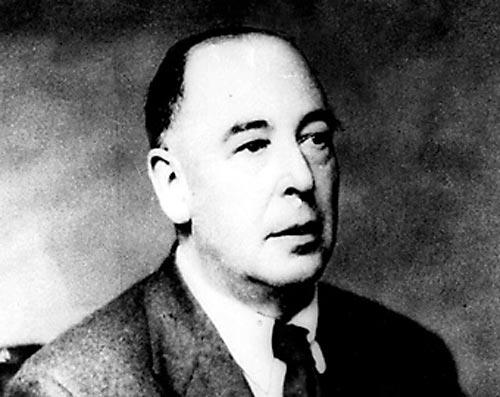
In C.S. Lewis' book The Screwtape Letters, Screwtape is a tempter who is the uncle and mentor to another tempter named "Wormwood." Screwtape writes to him the following advice on dealing with Wormwood's human "patient," i.e. how to keep him away from God, the Kingdom, and Church. God, in this context, is the "enemy" spoken of by Screwtape, and the discussion is how to deal with humans when they go through "trough" periods - periods of emotional and spiritual dryness....


He [God, the enemy] cannot tempt to virtue as we do to vice. He wants them to learn to walk, and must therefore take away his hand. And if only the will to walk is really there he is pleased even with their stumbles.

Do not be deceived, Wormwood, our cause is never more in danger than when a human, no longer desiring, but still intending to do our enemy's will looks round upon the universe from which every trace of Him seems to have vanished and asks why he has been forsaken: and still obeys...
[C.S. Lewis Screwtape Letters]


My God, My God, Why have you forsaken me?
- Jesus


The most mysterious thing about faith that I have discovered thus far in my life is how faith can hold on to God and continue in humility and obedience when all incentives are stripped away, and when the feelings of God's presence have vanished. Faith, in these cases seems to continue despite God: A stubborn refusal to relinquish faith and to remain steadfast. What is the basis for such faith? It transcends rational explanation. It is a conviction that comes from the deepest part of the soul, and dominates and permeates all aspects of our being. It is a faith that does not have the ability to be non-faith. It is as though one could not do otherwise. Even though the faithful one would like to let go and be relieved of this burden, their faith is too strong - it is compelling them and they cannot do otherwise. It holds on without reason. It is intangible and mysterious. And many of us will never encounter it.

To some they would see a faith that is shaky and faltering. The doubts are plaguing the mind and heart, and yet faith holds. It seems to those watching, and even to the person themselves, that such faith is faltering. But it is not faltering. Despite the doubts and turmoil the faith is actually solidifying - growing strong like a rock, or a tree whose roots spread out wide across the land and deep into the soil of the ground.

Should we even begin to speak of Job? Job's faith persisted despite the fact that God, himself was the enemy. Job was crushed by God. When Job desired a reason for his pain God only overwhelmed him. "I will question you and you will answer me." (Job 38:3) Rather than provide Job with peace and blessed assurance God only made Job tremble and say, "I despise myself." (Job 42:6) How does faith hold on when the object of faith is also the source of pain?

I have no desire for a Job-like faith. I would have to relinquish too much. Give too much. Fight too much. And, quite frankly, I don't know if I have what it takes. No one knows, of course, until they feel God's hand pressing them down. Few of us ever have to encounter this, though. So, it is easy enough to just live life.

But what Job gained was priceless. It was one of the most rare glimpse of pure faith that a human mortal can achieve. Job's faith in God shifted from a Job-centered perspective to a God-centered view, and this shift was complete. Job has no reason and nothing to gain by holding to his faith: "Curse God and die!" he was told. What a bizarre kind of faith that still holds on??? To hold on to the object of faith when the object of faith is the oppressor: I marvel at this.

My faith has been built in large part over the years on reasons, but what would keep me walking the faith when these reasons are painfully peeled away? This is the mystery.

Tuesday, October 17, 2006

Strange News


Pablo Picasso's "dream" painting has turned into a $139 million nightmare


Pablo Picasso's "dream" painting has turned into a $139 million nightmare for Steve Wynn.
In an accident witnessed by a group that included Barbara Walters and screenwriters Nora Ephron and Nicholas Pileggi, Wynn accidentally poked a hole in Picasso's 74-year-old painting, "Le Reve," French for "The Dream."
A day earlier, Wynn had finalized a record $139 million deal for the painting of Picasso's mistress, Wynn told The New Yorker magazine
The accident occurred as a gesturing Wynn, who suffers from retinitis pigmentosa, an eye disease that affects peripheral vision, struck the painting with his right elbow, leaving a hole the size of a silver dollar in the left forearm of Marie-Theresa Walter, Picasso's 21-year-old mistress.
"Oh shit, look what I've done," Wynn said, according to Ephron, who gave her account in a blog published on Monday.
Wynn paid $48.4 million for the Picasso in 1997 and had agreed to sell it to art collector Steven Cohen. The $139 million would have been $4 million higher than the previous high for a work of art, according to The New Yorker.
Cosmetics magnate Ronald Lauder paid $135 million in July for Gustav Klimt's 1907 portrait "Adele Bloch-Bauer I."
Wynn plans to restore "Le Reve" and keep it.
http://www.reviewjournal.com/lvrj_home/2006/Oct-17-Tue-2006/news/10274785.html


Diamonds are icing on $20 million wedding cake


LOS ANGELES (Reuters) - A confection billed as the most expensive wedding cake in the world makes its debut on Monday night in Beverly Hills, but is likely to cause indigestion.
The extravagant $20 million diamond-studded wedding cake, created by Mimi So Jewelers and cake designer Nahid La Patisserie Artistique, is the star attraction of the Luxury Brands Bridal Show and will be unveiled on exclusive Rodeo Drive.
"Where else would you debut a $20 million wedding cake but on Rodeo Drive?" said show organizer Ilona Sherman.
The cake is protected by a team of uniformed security guards at all times, she said. And there's no way it will ever be eaten.
"I think diamonds are too hard on the stomach," Sherman said.
http://news.yahoo.com/s/nm/20061017/od_nm/wedding_cake_dc;_ylt=AoMQfMT0VLUNGZOIUButrYMSH9EA;_ylu=X3oDMTA5aHJvMDdwBHNlYwN5bmNhdA----

and more on marriage...


Rush to marry ends in tragedy
KARACHI (Reuters) - A Pakistani man has committed suicide outside his fiancee's home after he thought he accidentally killed her while trying to persuade her to get married early, police said Saturday.
The man, Ahmed Ashraf, was shooting a gun in the air outside his fiancee's home in the southern city of Karachi on Friday as part of his efforts to persuade her to get married two months early when a stray bullet accidently hit her, police said.
"He was so eager to get married he stood in front of his fiancee's house and started firing shots in the air to catch her attention," said investigating officer Ghulam Hussain.
The young woman was coming downstairs when a bullet ricocheted off a wall and hit her. She fell down screaming "I have been shot," Hussain said.
"He thought he had killed her and within seconds shot himself. The girl is fine," Hussain said.
"It is a tragic accident. They were engaged to be married with their parents' consent on December 25. He was insisting they get married earlier."
Ashraf had told his fiancee, Naureen, he would do something drastic if she didn't agree to get married straight away. The woman insisted the marriage date had already been set and there was no need to hurry, Hussain said.
http://news.yahoo.com/s/nm/20061016/od_nm/pakistan_marriage_dc;_ylt=Asin_wSdHa9K4N7xqKMH9zkSH9EA;_ylu=X3oDMTA5aHJvMDdwBHNlYwN5bmNhdA--

Home sweet home meet the chocolate igloo


PERUGIA, Italy (Reuters) - Four Italians have constructed what they believe is the world's first full-sized chocolate igloo but they have yet to solve an age-old problem.
It still melts.
"It was a tough thing to do, much more difficult than building a normal snow igloo," Marco Fanti, 45, who used to race cars in desert rallies, told Reuters as he stood beside the 1.65-metre-high, dome-shaped traditional Inuit shelter made of some 330 dark chocolate bricks.
Fanti and fellow instructors at a survival school took 23 hours working with tricky, crumbling chocolate material to construct what they believe to be the world's first chocolate igloo for the Eurochocolate fair in Perugia.
They normally build one made of snow, for survival courses, within three to four hours.
Fanti said it has yet to be decided what to do with the 3.6- tonne igloo -- which is kept indoors and will start melting at above 30 C -- when the fair ends on Oct 22.
http://news.yahoo.com/s/nm/20061016/od_nm/chocolate_igloo_dc;_ylt=Ai7E0h3cmOeJh248DfBSleUSH9EA;_ylu=X3oDMTA5aHJvMDdwBHNlYwN5bmNhdA--

"Recognizing" Truth

Sometimes when we hear intellectual truth we recognize it at on a non-intellectual level. The truth "impacts" us with a certain force. This is particularly true with spiritual truths. For example, when someone tells us about certain aspects of the Creator God (his power and knowledge, his sovereignty or his love, and the Savior who came to die) we have the capacity to "feel" these truths. So, we may intellectually understand them and put our rational stamp of approval on them, but underneath the surface there is a sort-of spiritual frenzy going on. Not only are we understanding these truths, intellectually, but we are also absorbing them into our lives.


A simple example of this comes from the sermon I heard last Sunday. If a man is in love with a woman, he believes certain truths about his lover. Her eyes are blue, she has certain interesting characteristics, and she has a certain sense of humor. These are all "true" on a propositional level. However, for a man in love these truths have become absorbed into the deepest fabric of his being such that he does not have the ability to speak of such truths in a purely intellectual way. In fact, it is very likely that he may never have been able to intellectually and objectively analyize these truths about his lover. In the (very strange) case of love, truths are recognized on a non-intellectual level. So it is with spiritual truths.

On the other hand, of course, it is possible to merely give an intellectual nod to truth without absorbing truth in the way described above. The man who is not in love with the woman can intellectually describe certain truths about her in a detached, objective manner. Similarly, those who have never truly encountered God or never opened themselves up to the sense of divinity in the world may intellectually describe God and rationally believe in him. The degree to which we absorb truth may not be the same.

I point all this out to simply say that truth can be recognized on a non-intellectual level. We can experience truth. I believe that this implies that truth is greater than simply a correspondence between proposition and reality. In short, truth is more than intellectual/rational/objective. It is certainly all of these things, but I think it is more.


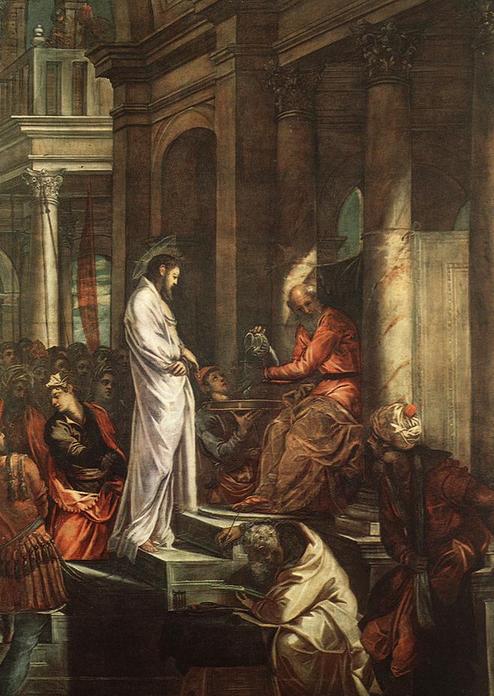
In speaking to Pilate Jesus said that "everyone of the truth hears me." (John 18:37) What does it mean to be "of" the truth?

I take this passage back to John chapter eight where Jesus accuses the religious leaders of being children of the devil, and it is the devil who "has no truth in him." (vs. 44) Now, it seems absurd to say that the devil has no knowledge of intellectual truth. It is the mark of the best liars that they know propositional truths so well that they can bend them and twist them any number of ways to suite them. Rather, it seems as though the devil has "no truth in him" because he stands in direct opposition to "the way, the truth, and the life," (John 14:6) which is Jesus, himself.

Hence, I think we recognize truth on a non-intellectual level because "truth" has much to do with our spiritual situation in relation to Christ and the Creator. It is as much a matter of our spiritual situation to Christ as it is our possession of propositional truth. I think the fact that we can recognize truth on a non-intellectual level is one clue that points this out.

[See my Aletheia Project for more essays and thoughts on truth.]
Illustration: Jesus before Pilate by Tintoretto

Monday, October 16, 2006

Savior, Madness, Heartache

You sit there in your heartache
Waitin’ on some beautiful boy to
Save you from your old ways
You play forgiveness
Watch it now, here he come
He doesn’t look a thing like Jesus
But he talks like a gentleman
Like you imagined
When you were young

We’re burnin’ down the highway skyline
On the back of a hurricane that started turnin’
When you were young

They say the devil’s water it ain’t so sweet
You don’t have to drink right now
But you can dip your feet
Every once in a little while
- from “When you were young” The Killers


God’s grace saves us from our sins. His blood atones for our past, our present, and our future. But can Jesus save us from heartache? Is the Savior also a hero? Can he rescue and carry us away in the sunset?…
It is one thing to say that sins are forgiven. It is another to “go and sin no more.” Personal sin is heartache and madness. Heartache presses itself upon us so heavy that we have no choice. Who chooses for us when the choice isn’t ours?…
Can the Messiah grant eternal life and also save us from ourselves? From self-destruction, addiction, sorrow, depression, despair, and the madness that drives us and pushes us – like the incessant beating of drums that is driving and driving, driving and pushing. Uncontrolled. We don’t even know. We don’t even know the drums exist. Can the Messiah deliver us from the drums? Can he save us from heartache?…
I am driven by evil. But I cannot see it. I am driven and blind. It just drives on…
What is the benefit of salvation from the external punishment of our sins if hell resides within us? This hell is maddening and deafening, and when madness deafens us all we hear is heartache. Can Jesus save us from heartache? Have we ever really believed that he could? Have we believed enough to risk?…
But it is a terrible choice to make: to open. The state of the vulnerable. It is greater than any other. Much better to embrace the arms of a stranger. Much better to drowned in addiction. These we can understand. We know where they go. We know what they deliver and we can live under the delusion that they will never extract their awful payment. There is less at stake than there would be to embrace the Savior. Pain awaits at the end of embracing our heartache…
But what if we embrace the Savior? What if we open our hearts? This kind of openness isn’t required when we embrace our heartache. But it is required if the Savior is to save us from our inner madness…
But what if the Savior fails? That is something we cannot bear. The Savior is the last symbol of hope in a world of madness. We want to hold out hope that the Savior saves some, even if he hasn’t saved us from heartache: the pastor and his pretty wife, the well-groomed young man handing out bulletins at the front of the church, the lady of many years who still makes cakes for the church social. Jesus has surely saved them from madness. There is hope for some, but not for me. Jesus is only a symbol for me: a Savior symbol. Saving others from heartache and madness, and maybe even saving me from my sins – but not from the heartache and madness inside.
Can we be saved from ourselves?
Where is my Savior, and is he only a symbol?


I am a wretched one. Who will save me from this body of death? (Romans 7)

Friday, October 13, 2006

Going Post(al) Modern

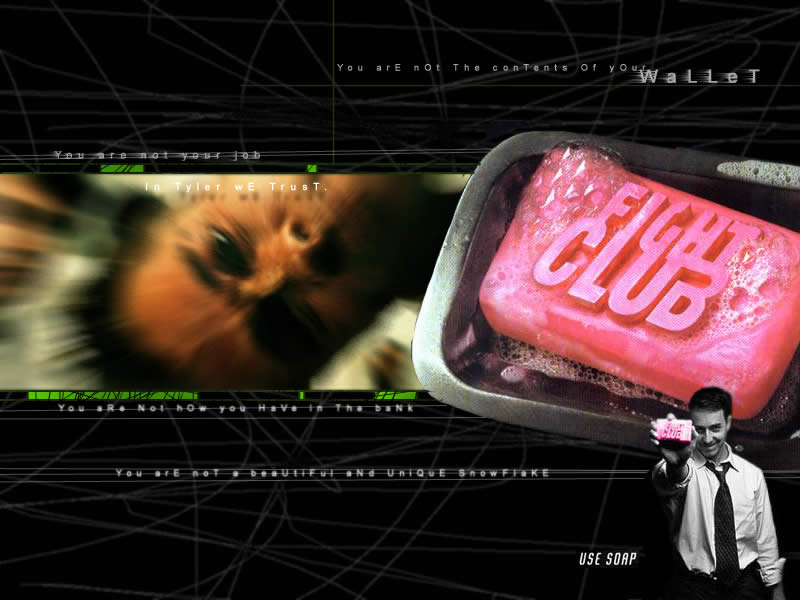
Fight Club centers on the solitary life of a lonely individual. Our hero is played by Edward Norton. His job is mundane, and his life outside of work is little better. His only "thing" is the stuff he buys for his apartment: designer items he selects with the greatest of care. His humdrum existence is interupted by the charismatic "Tyler."

Tyler is a sado-masochistic anarchist plotting to destroy civilization. He has vision and the energy to carry it out. People respond to him. People feed off of his passion, not the least of which is our hero who has found an inspiration to escape his monotony.

Together, the pair builds an army of disenfranchised young men looking for something greater than themselves. Eventually, as the plot unfolds we find that our hero and Tyler are actually one and the same person. It is a multiple-personality disorder to the extreme.


One thing that fascinates me about this movie is that the main character (played by Edward Norton, left) is so deeply divided. He is, at the same time, in love with all of his material possessions and, on a deeper level, desiring to blow it all up. He cannot, of course, blow it up, but this desire to escape his routine existence and participate in something bigger is so great that it actually causes a rift in his psyche and creates another personality. This personality can get rid of his stuff and pull him into something greater. But this is someone outside of himself, even if the person is a creation out of our hero's own imagination.

Is it too great of a stretch to make a comparison with our post-modern generation? We were born as consumers and have been programmed to respond to the marketing campaigns all bidding for our dollars. And we love our stuff: ipods, laptops, cars, clothes, movies, music. It's all great. But for all its greatness it locks us in. We, like the Fight Club character, become servants of our stuff, at least to some degree. Our interests become split. Perhaps we could even say that in our day people display the same personality split: Hanging on to our material possessions and the desire for something bigger and greater than ourselves.


So, in some sense today's person seems spiritually schitzophrenic: a post(al) modern character on the brink of utter destruction. Desiring to completely demolish his own civilization and yet unable to do so until someone from the outside intervenes. There is a cost to this destruction. And the Edward Norton character is unable to pay the cost. Only "Tyler" can make this happen.

I wonder if we are ready to pay the cost, spiritually. We can dabble in spirituality - meditation, reading, charitable giving, even prayer - but have we truly reached out for something greater to the degree that we have sacrificed everything.

The Fight Club character eventually must demolish his own house with all of the things he has so carefully selected. He must, in the end, completely disconnect from his previous life in order to achieve something greater. He must sacrifice.

The Kingdom is like that. Only those who have completely blown up their "stuff" can truly taste it. The "stuff" is whatever our old self holds on to. Whatever it is that we are depending upon for our survival. Whatever our crutch is that we lean on to get through the monotony and apathy of our lives. And that isn't easy, because it's a matter of survival. We must, quite literally, risk our lives. Do we need a "Tyler"? Someone from the outside? A Savior, perhaps?


The kingdom of heaven is like treasure hidden in a field. When a man found it, he hid it again, and then in his joy went and sold all he had and bought that field.
Again, the kingdom of heaven is like a merchant looking for fine pearls. When he found one of great value, he went away and sold everything he had and bought it.
(Matthew 13)

Thursday, October 12, 2006

Imagination


Traditionally discipleship has focused upon two areas—knowledge and skills. Churches have poured enormous energy into communicating knowledge about God through preaching, classes, and small groups. In recent years an increasing number of voices have challenged the effectiveness of information based discipleship. That has resulted in churches shifting their focus to skill driven formation—“how to” have a healthy marriage, share the gospel, or parent difficult teenagers.
However, knowledge and skill based models, while necessary components of spiritual formation, both miss the imaginative aspect of the human spirit. And by ignoring the intuitive capacity of the mind the church has essentially surrendered people’s imaginations to the pop secular culture without a fight....
Without significant re-cultivation and sanctification of the imagination, aided by God’s Spirit, a disciple will be incapable of weeding out sin and living obediently. Oswald Chambers understood this reality. He knew that if “your imagination of God is starved then when you come up against difficulties, you have no power, you can only endure in darkness.”


I think there is a distinction in this post between "transference" and "imagination."
Discipleship that focuses on transference will primarily busy itself with transfering doctrines or life-skills (the above quote calls these the "how-to's"). Nothing wrong with transference, in and of itself. It is good.

The problem, as I see it, is the neglect of engaging each other in a struggle of imagination. Only in the struggle can such doctrines and how-to's become relevant. It is one thing to simply absord the transfer of knowledge, but another thing altogether to struggle through what this means for me in my stream of life.

An example: To rationally ascent to the doctrine that God knows everything is one thing. To live my life with the knowledge that God's eye pierces into the deepest recesses of my soul....well, that's quite another thing. Much safer to just have a doctrine that I "believe" than to live my life with a feeling that I am saturated by the presence of God: that would be dangerous...