A LOVE SUPREME

I am now blogging at a new blog: erdman31.com

If you post comments here at Theos Project, please know that I will respond and engage your thoughts in a timely manner.

Tuesday, October 30, 2007

Shoot me

A few years back, Dr. Dave Plaster, a professor of mine, relayed a story to our class of a time when he was at Dallas Seminary working on his Ph.D. several years back. Dr. Plaster is a Grace Brethren and a pacifist. That was a bit of a problem because he was in a classroom full of non-pacifists and his wily Professor who was a bit antagonistic toward pacifists. The Professor assigned topics for a research assignment that included defending one's thesis in the classroom. Naturally, the wily Professor assigned Dr. Plaster the topic of pacifism. When it was Dr. Plaster's turn to defend, he presented his case for pacifism and then the floor was open for fellow students to open fire, if you will, on his case against war. The Professor was first to interject and embarked upon a lengthy polemic against the points presented, expounding every jot and tittle whereby Dr. Plaster (and other pacifists) were so clearly mistaken.

Dr. Plaster absorbed the barrage and responded with a scenario and a question: Let's say that my country is at war, and that I am a soldier. Let us further suppose that I have the enemy in my sites, and that all I must do is pull the trigger and effectively eliminate the enemy's life. This, of course, is my job as a soldier and my duty to my country. But now let's suppose that the enemy is a fellow brother in Christ. Are you telling me that I am obligated to pull the trigger and kill my fellow brother in Christ?????

The Professor gathered together his few things, rose from his seat, and exited the classroom.

Sunday, October 28, 2007

Wittgenstein

Ludwig Wittgenstein: The Duty of Genius
Ray Monk
1990
My Rating: 5 of 5 Stars


The entry on Ludwig Wittgenstein by The Shorter Routledge Encyclopedia of Philosophy (and by "shorter" we mean a mere 1,077 pages of small-type, double-column entries) states the following, "His writings have aroused great devotion because of the honesty and depth which many find in them. But it is important not to treat them with superstitious reverence. Rather they should be read in the spirit in which he intended, namely as an invitation to explore with as much integrity as possible one's own perplexities and what would resolve them."

Reading the above gave me pause. Why would a reputable philosophical encyclopedia feel compelled to provide a disclaimer against "superstitious reverence" toward a past philosopher? I can only imply that the author is concerned about a cult-following around the person and work of Wittgenstein. But doesn't this strike us as extremely odd? That at the end of the 20th century and as we embark on the 21st there are intelligent students of philosophy religiously devoting themselves to a philosopher not yet 50 years after his death? Admittedly, philosophy students are typically devoted to teachers and professors and even to philosophers of the past who write with the force of logic and truth. And yet I find no similar disclaimer in the Routledge entry on Plato, Locke, Kant, Hegel, or Russell. What is it about Wittgenstein that inspires such "superstitious reverence"?

The answer, I believer, is not simply to be found in the work of Wittgenstein but more so in his life. And this is where the Monk biography comes in. It bridges the gap between philosophy and life: "By describing the life and the work in the one narrative, I hope to make it clear how this work came from this man, to show - what many who read Wittgenstein's work instinctively feel - the unity of his philosophical concerns with his emotional and spiritual life." (xviii)

After reading Monk's biography I can understand why the philosophical establishment would see themselves obliged to disclaim any sense of religious devotion to Wittgenstein. Such devotion is simply the mirror reflection of a man completely dedicated to the questions of life that perplexed him, even tortured him. "Philosophy, one might say, came to him, not he to philosophy. Its dilemmas were experienced by him as unwelcome intrusions, unable to get on with everyday life until he could dispel them with a satisfactory solution." (3) Wittgenstein's ultimate solution to the problems of philosophy was to suggest that philosophy, itself, could not solve them. Or, at the very least, that philosophy has limits and parameters that it should not push beyond.

"What we cannot speak about we must pass over in silence." (Tractatus Logico-Philosophicus, section 7)

In brief, the life of Wittgenstein was one of passion and complete dedication to pursue the deepest and most meaningful questions of life. He was religious, deeply committed to his own ethical purity, and above all things he was a man who brought a relentless intensity to everything that he deemed important enough to warrant investigation. For example, Wittgenstein would engage the most brilliant philosophical minds of his day and simply wear them down. He had the mental, physical and emotional capacity to sustain the pursuit of a line of thought for hours and hours on end. In many cases, philosophers like Bertrand Russell would simply not have the capacity (or even the desire in some cases) to follow Wittgenstein until he was satisfied to conclude.

How many philosophers inspire "superstitious devotion"? How many thinkers are truly worthy of the dedication of their followers? When compared to Wittgenstein, most philosophers appear to approach philosophy as though it were a mere hobby. Wittgenstein's life displayed a sheer force of intellectual passion.

Rather than attempt to review the life and work, exhaustively, I will pick and choose a few interesting portions of Monk's biography that I found particularly intriguing.

Here I highlight a comment by Wittgenstein on belief in God and its relation to science and proof:
"Wittgenstein did not wish to see God or to find reasons for His existence. He thought that if he could overcome himself - if a day came when his whole nature 'bowed down in humble resignation in the dust' - then God would, as it were, come to him; he would then be saved....Both the atheist, who scorns religion because he has found no evidence for its tenets, and the believer, who attempts to prove the existence of God, have fallen victim to the 'other' - to the idol-worship of the scientific style of thinking. Religious beliefs are not analogous to scientific theories, and should not be accepted or rejected using the same evidential criteria." (410)

The above line of thought is intriguing in its own right, and certainly a matter that has come under a great deal of debate over the years. But, aside from the substance of what Wittgenstein says, what is particularly interesting to me is the context within which Wittgenstein developed these ideas. He was working at Cambridge in the early 20th century, where a scientific approach was presumed (in some form or another) by virtually all serious thinkers. To our "postmodern" ears the above statements seem less radical and a matter to be taken seriously for thought and discussion. I don't know that we can appreciate the degree to which these thoughts would have deviated from the philosophical orthodoxy of the day. Of course, deviating from philosophical orthodoxy was the least of Wittgenstein's concerns!

Wittgenstein began his Philosophical Investigations by engaging the Confessions of St Augustine. Says Monk, "For Wittgenstein, all philosophy, in so far as it is pursued honestly and decently, begins with a confession. He often remarked that the problem of writing good philosophy and of thinking well about philosophical problems was one of the will more than of the intellect - the will to resist the temptation to misunderstand, the will to resist superficiality. What gets in the way of genuine understandings often not one's lack of intelligence, but the presence of one's pride." (366)

Monk continues on this line of thought and cites Wittgenstein, himself:
"If anyone is unwilling to descend into himself, because this is too painful, he will remain superficial in his writing: Lying to oneself, deceiving yourself about the pretence in your own state of will, must have a harmful influence on [one's] style; for the result will be that you cannot tell what is genuine in the style and what is false....If you are unwilling to know what you are, your writing is a form of deceit. (366-67)

The Liar Paradox is a problem that develops when someone says, "I am lying." Is the statement true or is it false. If it is true, then it is necessarily false. If it is false, then the person has told the truth. It is a simple little game of logic, but it creates great problems for various theories of propositions. Personally, I have wondered whether or not such paradoxes do not reveal a fundamental flaw in ascribing truth value to propositions, that perhaps this implies that truth is a matter greater than propositions. Or perhaps it is simply a manifestation of the absurdities of the universe. In any event, here is Wittgenstein on the issue:

"It is very queer in a way that this should have puzzled anyone - much more extraordinary than you might think: that this should be the thing to worry human beings. Because the thing works like this: if a man says 'I am lying' we say that it follows that he is not lying, from which it follows that he is lying and so on. Well, so what? You can go on like that until you are black in the face. Why not? It doesn't matter." (420)

For Wittgenstein, then, the issue was really a non-issue. But why? Monk says that it is because what needs to be explained is also why the question matters. In other words, justification is needed for the theoretical constructs that demand an answer to the question. "His [Wittgenstein's] point was rather that a contradiction cannot lead one astray because it leads nowhere at all. One cannot calculate wrongly with a contradiction, because one simply cannot use it to calculate. One can do nothing with contradictions, except waste time puzzling over them." (421)

Wittgenstein was also interested in Freud and dream interpretation. "It was the idea that dream symbols form a kind of language that interested him - the fact that we naturally think that dreams mean something, even if we do not know what they mean." (448) Monk continues, "What puzzles us about a dream is not its causality but its significance. We want the kind of explanation which 'changes the aspect' under which we see the images of a dream, so that they now make sense. Freud's idea that dreams are wish fulfilments is important because it 'points to the sort of interpretation that is wanted', but it is too general." (449)

Says Wittgenstein, "Freud very commonly gives what we might call a sexual interpretation. But it is interesting that among all the reports of dreams which he gives, there is not a single example of a straightforward sexual dream. yet these are as common as rain." (449) Monk continues summarizing Wittgenstein: "This again is connected to Freud's determination to provide a single pattern for all dreams: all dreams must be, for him, expressions of longing, rather than, for example, expressions of fear. Freud, like philosophical theorists, had been seduced by the method of science and the 'craving for generality.'" (449)

This next statement in regard to Freud is interesting to me: "There is not one type of dream, and neither is there one way to interpret the symbols in a dream. Dream symbols to mean something - 'Obviously there are certain similarities with language' - but to understand them requires no some general theory of dreams, but the kind of multi-faceted skill that is involved, say, in the understanding of a piece of music." (449)

The above reflections in relation to Freud and dreams are in line with Wittgenstein's approach of going to the particular thing rather than the general. Furthermore, Wittgenstein does not necessarily go to the particular thing with the intent of using it to develop overarching theories, perhaps what we might call a "metanarrative" - an overarching explanation for all things. This simply wasn't Wittgenstein's primary concern, and as such I think he is able to demonstrate insight into the "skill" required to interpret dreams.

More on Wittgenstein's religious outlook. Monk cites W:
"An honest religious thinker is like a tightrope walker. He almost looks as though he were walking on nothing but air. His support is the slederest imaginable. And yet it really is possible to walk on it." Says Monk, "Though he had the greatest admiration for those who could achieve this balancing act, Wittgenstein did not regard himself as one of them. He could not, for example, bring himself to believe in the literal truth of reported miracles:
'A miracle is, as it were, a gesture which God makes. As a man sits quietly and then makes an impressive gesture, God lets the world run on smoothly and then accompanies the words of a saint by a symbolic occurrence, a gesture of nature. It would be an instance if, when a saint has spoken, the trees around him bowed, as if in reverence. Now, do I believe this happens? I don't. The only way for me to believe in a miracle in this sense would be to be impressed by an occurrence in this particular way. So that I should say e.g.: "It was impossible to see these trees and not to feel that they were responding to the words." Just as I might say "It is impossible to see the face of this god and not to see that he is alert and full of attention to what his master is doing." And I can imagine that the mere report of the words and life of a saint can make someone believe the reports that the tree bowed. But I am not so impressed.'" (464)

The above can be a bit confusing in several places, but I added bold/italics to the second to last sentence because it seems to emphasize the main point of Wittgenstein's approach to miracle, namely, that the event may not necessarily occurred, but the religious significance of those involved impressed them to the point that it was as though it had actually happened.

Monk continues and notes that Wittgenstein's belief in God "did not take the form of subscribing to the truth of any particular doctrine, but rather that of adopting a religious attitude of life. As he once put it to Drury: 'I am not a religious man but I cannot help seeing every problem from a religious point of view.'" (464)

Can one "sum up" Wittgenstein's philosophy? Likely not! However, this one sentence, perhaps might be a start in understanding Wittgenstein's reflections as they relate to his contemporaries: "Partly under Wittgenstein's influence, the Theory of Knowledge had been subordinated to the analysis of meaning." (472) So, in this sense, the study of theories of epistemology eclipse into analyzing meaning: meanings of words and meanings of objects and the meanings of anything that we encounter in life that yields meaning. In this sense we are talking about a focus on interpretation. Interpretation was also the occupation of Heidegger and Gadamer in their own ways, and from there, philosophical thought (and even non-philosophical thought) seems to take of in a variety of directions.

In Zettel, Wittgenstein states, "Only in the stream of thought and life do words have meaning." For Wittgenstein, Monk notes, "Practice gives the words their sense." (573) This is a comment on context. Here, Monk comments on this idea of context and follows this by citing Wittgenstein: "The thrust of Wittgenstein's remarks is to focus the attention of philosophers away from words, from sentences, and on to the occasions in which we use them, the contexts which give them their sense:
'Am In not getting closer and closer to saying that in the end logic cannot be described? You must look at the practice of language, then you will see it.'" (578-79)

The above goes to the idea of a "framework" for thinking and interpreting. Monk states Wittgenstein as follows: "A framework itself cannot be justified or proven correct; it provides the limits within which justification and proof take place....We cannot make sense of anything without some sort of framework, and with any particular framework there has to be a distinction between propositions that, using that framework, describe the world, and those that describe the framework itself, though this distinction is not fixed at the same place for ever." (571) This reminds me of Gadamer's insistence that "tradition" and "prejudice," far from being things we should despise are the very preconditions under which all thought takes place. Interesting that for Wittgenstein we need to distinguish the propositions within the framework from those that describe the framework, and yet this cannot ever be "fixed." Monk cites an analogy that Wittgenstein uses for this point: "...the river-bed of thoughts may shift. But I distinguish between the movements of the waters on the river-bed and the shift of the bed itself; though there is not a sharp division of the one from the other." (571)

The life and philosophy of Wittgenstein is intense. His works, though short in length and few in words, are dense. Monk's biography, however, is highly readable and comes highly recommended. It traces Wittgenstein's philosophy as it relates to his contemporaries, however, it is not simply a portrait of the development of philosophy. Monk skillfully combines life and thought in such a way that one cannot help but be impressed by the person. This biography is helpful for its philosophical reflections, but it is fascinating for the portrait of the person - a person whose life and works have inspired a "superstitious reverence" that should make all establishment philosophers wary!

All that philosophy can do is to destroy idols.

Saturday, October 27, 2007

Friday, October 26, 2007

igotscrewed

Ok, just because everyone cares so much, I am writing to update you on the ipod situation. A few months back when I was having all that trouble with my ipod nano and the related Worst Buy Warranty, I wrote a review on Amazon.com entitled "igotscrewed"....for some reason it hasn't shown up yet.....Remember the recent rants??? My old, ridiculously unreliable ipod nano continued to malfunction at every turn, resulting in a trip to Best Buy to get the stupid thing exchanged - sorry, looks good to us: Yes, you morons! But it doesn't work when I go for a run!
Sorry, sir, you'll have to wait for the Geek Squad.
Uh, what??? Ok

....and waiting and waiting....and leaving the store.....

So, the stupid ipod finally died. With that I realized how much I was relying upon technology to make my running a satisfying venture. So, I said, "screw it" - I'm running with only a stop watch. (My runs, of course, have been slow and short due to my recovering knee from the last Half I ran.)

Having recovered the joy of the pure run, I went to Worst Buy yesterday with my dead ipod and believe it or not a righteous dude helped me at the service desk and said I could have $199 in store credit.

Yes!

So, for the $199 I was able to double the storage and I now have a nifty 8 gig 3rd generation ipod.

We will wait to see if it actually works. It looks cool. But "ipod without works is dead."

The 3rd generation ipods are now square (or very close to square), which is unlike the tall, rectangular shape of the 2nd generation ipods (my old piece of trash ipod was 2nd gen). This, of course, means that I have the privilege of purchasing a new $30 armband from Nike!

Well, that's all the Grrrrrrrrrr I have for today. Have a good weekend.

Oh, yea, there's one more thing. The last thing the guy at Worst Buy asked me as I was checking out was, "Do you want to buy the Warranty with that, sir?"

Thursday, October 25, 2007

Black Hole Sun


This is a group called The Section Quartet. Compare with Smells Like Teen Spirit video.

Monday, October 22, 2007

Stamp me stupid

Does anyone remember the danged stamp rate??? I've got like three or four different stamp types each with a frakin' different postage rate on it...I finally found one that says "First-Class" and "Forever," so hopefully that will work......

Sunday, October 21, 2007

You Do Not Belong Here

"...so in Christ we who are many form one body, and each member belongs to all the others..." Romans 12:5

After eleven chapters of dropping theological bombshells the after shocks of which the church is still trying to understand, Paul begins chapter 12 of his letter to the Romans by urging each believer to present his or her body as a "living sacrifice." This imperative to present one's body is followed up by an appeal not to "conform to the world," but to be transformed (think "metamorphosis") by a renewal of the mind (the nous). The result is mind and body sacrificially dedicated to God.

Then verse 3 shifts us into our discussion of the body of Christ. First off: Don't think more highly of yourself than you ought to. And then we move into the metaphor of a body. One body with many "members" or "parts." We all have various functions: The body has a purpose and each part of the body has a different function. And yet we are all somehow working together. This is something of a task-oriented Christianity. No surprise that Paul would begin commenting on the fact that the body is here to do something; that we all work together. Paul was the first major missionary. He was a "go getter" as we say here in rural Indiana. Paul fearlessly plowed forward into new territory to spread the Gospel and establish new converts and new churches. The same energy that he had put into squelching the faith and persecuting members of the Jesus movement known in some circles as "The Way" was now redirected toward the spread of the "good news" of reconciliation to God through faith and through Jesus.

Generally speaking, I think that most American churches resonate with the idea of function. Each church has an all-you-can-eat buffet of ministries and programs to get involved with, often listed in helpful summary format within your weekly bulletin.

Function.

Task-oriented.

Rick Warren writes a book entitled The Purpose Driven Church and the danged things get bought off the shelf like Spock-ears at a Star Trek convention.

Back to the passage.

The task-oriented Paul now makes an interesting move: He follows function with belonging. We who are many form one body. Oh, and by the way, "each member belongs to all the others." This is the translation from the NIV, which focuses on "belonging." Function is critical for Paul, but it is rooted in our belonging one to another. What does this "belonging" entail, I wonder?

Commentator J.D.G. Dunn finds this belonging (or "one another") terminology to be "a slightly odd variation of the body metaphor." However, it serves very effectively to bring out the degree of interdependence which Paul regards as the most important point to draw from the body imagery (here as in 1 Cor 12; also Eph 4—note v 25; “each member belongs to all the others”—NIV), thus underlining the fact that the body language is primarily for Paul an ecclesiological rather than Christological concept (hence again the variation in terminology as between 1 Cor 12:12-13 and Rom 12:4-5). The consequence for ecclesiology also needs to be borne in mind: as Käsemann notes, “No ecclesiastical hierarchy can be deduced as constitutive from the motif of Christ’s body.” (WBC p. 724)

I find it interesting that Dunn calls this idea of interdependence and belonging to be the "most important point to draw from the body imagery." Why is this the most important point? I would venture to suggest that without interdependence that a sense of real "belonging" that is its foundation, the body of Christ merely becomes a task-oriented church that may get things done. At this point we lose a true sense of belonging amongst our members. "Church" takes on something of the corporate model where we clock in, do our job, then clock out and go about living our own lives and going about our own personal business. Without feeling a true sense of belonging a member of the body of Christ finds that a wedge is driven between "church life" and "personal life." We have a working relationship with the other members. But we don't really belong.

Dunn also comments that the "body" is more than a mere metaphor, but is rooted in the real-life context of the community of the early church: "the body imagery is actually an expression of the consciousness of community and oneness experienced by the first Christians as they met 'in Christ.'" (WBC p. 724)

Interesting comment by Mr. Dunn. Though the early church had a sense of purpose and function, they lived in a very closely connected community. We recall Acts chapter 2:
They devoted themselves to the apostles' teaching and to the fellowship, to the breaking of bread and to prayer. Everyone was filled with awe, and many wonders and miraculous signs were done by the apostles. All the believers were together and had everything in common. Selling their possessions and goods, they gave to anyone as he had need. Every day they continued to meet together in the temple courts. They broke bread in their homes and ate together with glad and sincere hearts, praising God and enjoying the favor of all the people. And the Lord added to their number daily those who were being saved.

Therefore, when Paul speaks of "belonging," he is not necessarily issuing an imperative, but is expressing something that already had occurred and was currently being experienced in the early church - the communities understood belonging because they lived it out. This may also shed light on the imperatives in the book of Hebrews. Perhaps the encouragement to "not give up meeting together" in 10:25 refers to the exhortation to "encourage one another daily" back in 3:13. Do these references provide another instance of the early church living out community and developing a true sense of belonging? By living in such close proximity as to be able to actually encourage each other daily? Lane indicates that this may be the case: "The admonition 'encourage one another every day' may actually presuppose a daily gathering of the house church, which would provide the occasion for mutual encouragement (cf. Windisch, 31; Michel, 106)." (WBC, p. 87)

So, where does that leave us as churches here in America? I would argue that most churches are "busy." Some more busy than others. Some more active than others. Some more purposeful than others and some who get much more done. We have tasks that accomplish things and make a real difference in the world, while there are others of us that are just kind of busy without any true impact. Essentially though, I think we all have tasks that we are trying to do. Ministries, programs. More ministries, more programs. But all without true belonging.

Do you truly experience belonging in your local fellowship?

Are there other believers who know the real you? Your hopes and dreams, your deepest fears? Are there people who understand your weak points? People who know what gets you excited in life (no matter how quirky or strange!)? Are there people who have your back? Who care about your soul? People who know your soul?

But then we could flip it around? Do you have souls for which you care for? Can you say that there are other believers who belong to you?

Not likely.

Belonging simply isn't a priority. And why should it be? The early church faced serious persecution in some cases. In other cases, they were religiously ostracized from fellow Jews or viewed with suspicion by local Gentile governments. You really need community when community is all you've got.

We don't have persecution in America. (And no, the existence of the Democrat Party and the release of the Al Gore movie does not, it turns out, qualify as persecution.) We've got cable channels we never watch and huge vehicles that can drive us places that we will never go. We don't really need belonging, do we???

Also, in the early church there was a lot to work out in regard to this new Christian faith and way of life. Who was Christ? God or man? What do we do about food that has been sacrificed to idols? What about the Law of Moses? Circumcision? There was a lot to talk about, and then there was the whole aspect of understanding what the new birth meant and how salvation worked out in the living of this new life of servanthood and discipleship to Christ.

Thankfully we have this all worked out these days. Have a doctrinal question? Go ask your pastor - he went to seminary. We have weekly sermons that tell us how we are to live and surely that has to be good enough.

Belonging?

Nah.

But perhaps all is not well in paradise. Sin issues seem prevalent in churches. For example, those that are "good conservative" churches (see Ted Haggard) are not immune from issues of marital infidelity. Marriages crumble at such a fast rate that even "the world" has a tough time keeping up. And it ain't because people don't know better, either. I have a hard time believing that "good Bible preachin'" is the answer to all of the marriage woes - as if people didn't already know that a broken marriage is not a good thing. And although I have zero experiences in the area of marriage (and by God's good graces I never will!) it strikes me as a bit silly to think that using "biblical counseling" as a catch all is going to have a real impact on layers upon layers of distrust and anger that builds up between two people.

Oh, and of course there are the addictive and compulsive behaviors that we don't really talk about because....uh...because those things are kind of uncomfortable to talk about....and, well, yea.....better to just deal with stuff like pornography, compulsive eating, anxiety, and that "indiscretion" with the co-worker.

But seriously, though. Where would you go if you really wanted to deal with your stuff? Yea, I mean that kind of stuff. The stuff that you are too ashamed or embarrassed to admit to anyone except....well, except to people with whom you experience authentic belonging. Do you really belong to a group of believers who know you as well or better than you know yourself?

The fact is that for all of the money we pour into our churches we have little to show for it in terms of belonging. Where are the forums and opportunities to truly guard against the "deceitfulness" of sin, as Hebrews 3 talks about? This deception is most often self-deception. But where are the caretakers of our souls? To whom do we "belong"? Again, more Bible isn't always the answer. Many of our conservative Christian churches use "Bible" as a band-aid for a flesh wound. What we really need is a chance to understand how the Bible works out in my life and the lives of those who belong to me. I think the complexity of the current age demand it. Preprepared answers don't cut it, anymore. No matter how Biblical they are. Each age and culture faces issues that require the Scriptures to be examined anew. Not to study simply to find out "what it meant back then," but to explore the implications of faith for the now.

The American church today is a social gathering alongside a desire to get some things done. But what does this mean for a pomo generation? Issues of isolation and compulsive/addictive behavior are common place. It's all amplified. But how do we deal with these things within institutions where we don't belong to anyone and they don't belong to us.

The fault of the weakness of the church in the postmodern age has nothing to do with so-called "godless" postmodern philosophers like Nietzsche, Derrida, or Baudrillard. I no longer take any conservative Christian leader seriously who believes that abstract philosophy can stand up to the church and create the current moral impotence that plagues us. Our failure is not a failure of abstract ethical theorizing or a need to take a stand for the "correspondence theory of truth." This is just silly. I say the following with no apology or reservation:

If the gates of hell cannot stand up against the church, then no postmodern theorist can either

But Postmodern theory is not the problem. The threat is not external, the issue is internal. It is a pride in institution that supersedes authentic relationship.

American Christianity has no belonging. Consequently the body has weakened and atrophied. We are attempting our tasks and striving to fulfill our function in an anemic state. How unfortunate. The body of Christ was meant to represent Christ. Yet, for all practical purposes Christ's body is still wheezing in the grave, too weak to emerge and make a difference in the world.

The most fundamental aspect of the body of Christ is true belonging. It is only when we truly belong that we can begin to make a real difference in the lives of the 21st century believer and demonstrate to the world that the body of Christ is, in fact, alive and no longer lying, weakened and cold, in the grave. But this cannot occur until each member belongs to all the others.

Thursday, October 18, 2007

Sunday, October 14, 2007

"God did not make Adam and Steve"

Over at "Not That There's Anything Wrong With That!" Sam presented us with the following scenario:

Here's the thing: John comes to church, he is a new convert. The pastor asks him after the service to tell a bit about himself and he says that he is a successful businessman, basically an agnostic, who has been feeling a sense of conviction for some time and started reading the bible and decided that he believes in Jesus, that Jesus is his savior.

The pastor is really excited. A new convert, someone who can be discipled!

Then he says that after having been in love for 2 years, finally, 5 years ago he married Jack and they have one adopted child Julie, that they got from Sri Lanka, who is now 4 years old.

What/how would you want your pastor to continue the conversation?
[1]

The above situation reminds me of various mission efforts to the Native Americans a century or two back. As I understand it, certain missionaries encountered polygamy among various tribes. They elicited converts to Christianity and then had a problem: there were families with multiple wives and children from these wives. The problem? Polygamy is a sin. The solution? "Send away the slave woman!"[1] So, they had to pick a wife, perhaps the first one they married, and send the other(s) away with their children. As I understand it, this created a great deal of difficulty and poverty for the families that were sent away and had no means of supporting themselves.

The above "solution" strikes me as cruel and shortsighted. But what then do we do with Sam's "Adam and Steve" scenario of the new convert (John) who brings to the church a relationship with Jack that involves a child, Julie?

My primary thought is that the American church has very little organizational capacity for correctly and compassionately engaging John and his family. For example, the current church model is that believers meet on Sunday morning and may or may not have other "ministries" or "programs" that they are a part of. So, basically, if you believe that homosexuality is wrong or perhaps not the best way to do things, then you have to ship the guy (in this scenario, John) off to "counseling" (or some other such ministry/program) or else you just kind of lay down the law (in a nice way) and say that we don't do things that way in these here parts so you can shape up or ship out.

So, we either have to issue an ultimatum or else send John to counseling. In the former situation I think we force a hasty decision on a new believer that he may not be entirely ready to deal with, in all of its many ramifications (i.e. the moral issue, issues of family/love, caring for a daughter, splitting a home, etc.). In the case of sending him to counseling right away this makes him feel freakish from the very beginning, and this is very unfair. The fact is that anyone who comes to Christ is going to have baggage, and they need a close-knit community and a group of individuals to share their faith with and to work through baggage that they bring in and baggage that they accumulate while being a believer. (The little-known secret, of course, is that most of us in nice churches have even more baggage that usually gets lost in the shuffle, and my experience is that you accumulate quite a bit of baggage in church circles because we often do not have the contexts for dealing real issues.)

The point thus far is simply to say that the current Sunday morning Christianity in America has no human or even biblical way to appropriately deal with Sam's scenario because we are an event-oriented institution. At our most fundamental level we are not relational. At our most fundamental level we are institutional and obsessed with "events."

Ideally, all believers are not simply a hodge-podge group of people that meet once a week to sing and watch a sermon. Rather, the best scenario that I can see would be that when John enters into a fellowship of believers he is immediately plugged in with a group of believers with whom he can meet regularly and begin to share his life. In fact, in my mind's eye I imagine that it was probably through contact with this group of believers that he was able to come to faith, rather than on Sam's scenario where the guy happens across a Bible and starts reading.

Within this very small group of caring believers John can begin to explore who he is with people who are ready to care for his soul and impart grace into his life. These would be people who would be primarily interested in getting to know John, the person, and finding out what faith looks like for his situation. They would be interested in John, regardless of where they stood on the homo issue. If they believed that God stands against homosexuality, they would present their reasons and interact with various biblical passages. But then they would allow John the respect as a fellow believer to work through these issues himself. (This fulfills the Galatians 6 "bear each other's burdens" exhortation, as well as the Philippians 2 encouragement to "work out your salvation.") Furthermore, this caring yet insightful group of believers would suspend judgment and allow themselves to reexplore and reexamine an issue that needs to be reexamined.

In John's case there is no simple "solution," the matter requires time and care. I would also suggest that the answer is not clear, either. In the case of the Native Americans, I would suggest that the missionaries should have continued to allow the practice of polygamy for those who already had multiple wives. The alternative brought pain and disruption to the existing family and culture. One could move the people towards monogamy, but this would be a movement over time.

This same line of reasoning must be a part of the consideration of John's relationship with Jack and to their daughter Julie. John needs to have room to understand his scenario for himself and in relation to all of the various facets of his life. He needs to take the time to explore and discuss with a group of believers who can get to know him and minister with him over a period of months and years.

Unfortunately, Sam's scenario cannot be answered in the existing church framework. One is hard pressed to find an American church that truly acts in unison as the body of Christ. We have many "churches" but no body. And the sad thing is that there is no reason for someone like John to ever have any interest in Jesus Christ, because the Body of Christ is completely impotent. We have nothing to call John to - no true community or real fellowship. So, as unfortunate as it is, I believe that Sam's scenario remains an impossible quandary. Until the power of Christ is displayed in authentic relationships and true community we should expect very little.

Blogoneutics - "Snurfing"

Here at the Theos Project we track the current shifting of culture by observing the change of language - or vica versa. This is particularly true in relation to how technology over the last 100+ years has changed the way we live and think.

Our current word is "snurfing." I take it from a recent Comcast commercial. Comcast is currently running commercials where they coin terms (like "televisiphonernetting") that relate with how we use technology. "Snurfing" is surfing online when one is supposed to be on the phone. This most often occurs by members of the male gender when talking to their significant female other. Or is it???? Regardless, I must raise my hand as being guilty of this quite often. Even as recently as last night. (Sorry, Mom!)

Saturday, October 13, 2007

Warranted Christian Belief - Kant

Alvin Plantinga
Review of Warranted Christian Belief (2000)
Chapter 1 - Kant


The interest of Plantinga's book, Warranted Christian Belief (referred to here as WCB) is whether Christian belief is rational, reasonable, justifiable, or warranted. (p. 3) The first two chapters form Part 1 address whether there is a question. That is, are we even able to talk, sensibly, about "God." Says Plantinga,
"It seems many theologians and others believe that there is real difficulty with the idea that our concepts could apply to God - that is, could apply to a being with the properties of being infinite, transcendent, and ultimate. The idea is that if there is such a being, we couldn't speak about it, couldn't think and talk about it, couldn't ascribe properties to it." (4)

The first chapter addresses that great philosopher, Immanuel Kant:
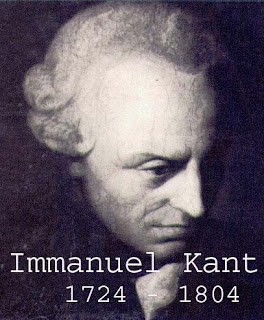
"It seems to be widely accepted, among theologians, that Kant showed that reference to or thought about such a being (even if there is one) is impossible or at least deeply problematic, or at any rate much more problematic than the idea that we can refer to and think about ourselves and other people, trees and mountains, planets and stars, and so on." (5)

The first thing that Plantinga notes is that Kant, himself, seems to refer to "God" and to issues of "faith." Plantinga references Kant's famous statement, "I have therefore found it necessary to deny knowledge in order to make room for faith." (9 note 13)

The next matter is a problem of interpreting Kant. Specifically, it has to do with his concept of noumena (or Dinge an sich) and phenomena. Plantinga differentiates two interpretations: A "Two World View" and a "One World View." The more traditional view is the Two World perspective. Here the noumena is completely separate and distinct from the phenomena. We can experience the phenomena, but not the noumena. Plantinga explains by way of summary the Two World View:

"This is the more traditional way of understanding Kant, the way Kant was taken by his great successors. To put it briefly and all to baldly, there are two realms of objects; our experience is only of one realm, the realm of phenomena, which themselves depend on us for their existence; if we should go out of existence, so would they. That is because the phenomenal realm is somehow constructed by us out of the given, the date, the raw material of experience. The noumenal realm, however, is not thus dependent on us but is also such that we have no intuition, no direct experience of it." (12)

Yet on the One World view the noumena is basically the world, while the phenomena is the way that we perceive that same world. Of this view Plantinga says,

"There is only one world and only one kind of object, but there are (at least) two ways of thinking about or considering this one world. All objects are really noumenal objects, and talk about the phenomena is just a picturesque way of talking about how the noumena the only things there are, appear to us. The phenomena-noumena distinction is not between two kinds of objects but, rather, between how the things are in themselves and how they appear to us." (12)

Plantinga's concern is not with which interpretation of Kant is correct, but whether either interpretation of Kant, so taken, constitutes a reason that we cannot think about God or discuss the question of who God is. As such, Plantinga deals with both the One World and Two Worlds interpretations as they relate to the question of whether or not it is possible to speak of God.[1]

Plantinga dismisses the One World view rather quickly stating that the issue of "God" on this view poses no special problem, for if everything is noumena then this includes God and there is no problem with knowledge of God that is not true of other knowledge:

"For present purposes, what we need to see is that on this way of thinking, it would not really be the case that our concepts fail to apply to God in such a way that we cannot refer to and think about him. What would follow, given that he is a noumenon (of course, in this way of thinking, everything is a noumenon), is that God would not have any of the positive properties of which we have a grasp....Here there would be nothing at all special about God; what holds for him also holds for everything else." (16)

The Two World interpretation becomes more interesting, particularly the more "radical" view. Plantinga sees two different forms of the Two World interpretation. The first is the "moderate" subpicture. Here, we may refer to the Dinge (the noumena), but it is merely a matter of speculation. There is no real knowledge of Dinge, rather it it is reduced to opinion and conjecture. "God" would be a part of the Dinge and all of the concepts we apply to "God" is just guess work. Still, Plantinga does not find in this moderate view the suggestion that our concepts do not, in fact, apply to God, and as such it does not represent a threat to any project (such as Plantinga's) that seeks to inquire as to whether it is rational/reasonable/etc. to believe in God.

I find the moderate subpicture very interesting because it does not eliminate the "speculation," but rather makes the more mild (and perhaps more threatening) suggestion that such speculation is trivial. In this way, then, we have a reflection of much of the greater American culture at large, that is, that our speculation about God is only as important as the meaning that it produces within the believer. So, the speculation is "trivial" because what we say about God is nothing that we know. If, however, it produces something significant for the believer then it becomes valuable.

On to the more "radical" subpicture.

"On both versions of the two-world picture, the appearances are distinct from the things in themselves. The appearances are objects; they exist; they are empirically real. But they are also transcendentally ideal. And what this means, in part, is that they depend for their existence on us (on the transcendental ego[s]) and our cognitive activity. We ourselves are both noumena and phenomena: there is both a noumenal self and an empirical self." (18)

This view becomes more complicated. For example, we are now "transcendental egos" such that we are both noumena and phenomena. As a transcendental ego we undergo experiences, which is a result of the things in themselves impinging upon us. This "impinging" is the experience. This is a rather confusing state of affairs, as Plantinga notes, "As it is initially given to us, this manifold of experience is a blooming, buzzing confusion with no structure." (18)

That we are both noumena and phenomena, then, implies to me that we have the noumena impinging upon us, but that we also impinge upon other(s) is some way. Regardless, we have the manifold of experience, which is a blooming and buzzing confusion. So, what do we do? Impose structure, of course: "We impose structure and form on it, and in so doing we construct the phenomena, the appearances. So the phenomena, the things fur uns, are constructed out of the manifold of experiences." (18)

Interestingly, for Kant this structuring does not necessarily occur at the conscious level: "Kant says we are largely unconscious of the activity whereby we structure the manifold and construct the phenomena. Still, it proceeds by way of the application of concepts to the blooming buzzing manifold of experience."[2] (18)

How does the structuring occur? Through "rules" and "law." Plantinga cites Kant as saying, "Sensibility gives us forms (of intuition) but understanding gives us rules." (19) What is the relation of "rule" and "law"? Again Plantinga cites Kant,

"Rules, so far as they are objective...are called laws. Although we learn many laws through experience, they are only special determinations of still higher laws, and the highest of these under which the others all stand, issue a priori from the understanding itself. They are not borrowed from experience; on the contrary, they have to confer upon appearances their conformity to law, and so to make experience possible. Thus the understanding is something more than a power of formulating rules through comparison of appearances; it is itself the lawgiver of nature." (19)

So, Plantinga suggests that the rules synthesize the manifold of experience. The lawgiver of nature structures the blooming and buzzing confusion of experience. Plantinga calls this the heart of the radical subpicture. On this view, the process of structuring experience results in the "phenomena."

Plantinga provides an example of a "rule" providing structure: "Consider your concept of a horse: it instructs you to associate, think together a variety of representations, a variety of items of experience, thus unifying that bit of manifold into an empirical object: a horse." (19)

In the One World view and also on the moderate subpicture Plantinga did not see a threat to applying our concepts to God. However, such is not the case on the radical subpicture. On this view God is noumenon: "God would not be something we have constructed by applying concpets to the manifold of experience (God has created us, we have not constructed him.) So, on the radical subpicture, we can't refer to, think about, or predicate properties of God." (20)

The results of the radical view might be damaging and stop us in our epistemological tracks, but Plantinga concludes that the radical view "displays a deep incoherence." (20) After discussion various possible solutions to the perceived incoherence Plantinga concludes by way of summary: "If we really can't think the Dinge, then we can't think them (and can't whistle them either); if we can't think about them, we can't so much as entertain the thought that there are such things. The incoherence is patent." (29)

One of the issues that I see as problematic for the radical viewpoint is how it is that the noumena "impinge" on us while at the same time remaining unthinkable and distinct. That is, if they are truly distinct and disjointed - if the noumena is truly transcendent - then it would seem problematic that it could still "impinge" in such a way as to create "experiences" for us to structure. I do note, however, that this problem is the same that theology must reckon with. For example, how is God truly and wholly Other - transcendent - and yet immanent enough to intrude into our reality and impact the world in which we operate. So, it seems as though some of these problematic issues surface in various areas of thought.

Having concluded that the radical subpicture is incoherent, Plantinga concludes this chapter by noting, "It doesn't look as if there is good reason in Kant or in the neighborhood of Kant for the conclusion that our concepts do not apply to God, so that we cannot think about him. Contemporary theologians and others sometimes complain that contemporary philosophers of religion often write as if they have never read their Kant. Perhaps the reason they write that way, however, is not that they have never read their Kant but rather that they have read him and remained unconvinced." (30)

Notes and References
[1] In regards to whether the One World or Two World interpretation is correct Plantinga does say the following regarding the One World interpretation: "Although this second picture is perhaps now the majority opinion, it seems a bit difficult to reconcile it with Kant's own view that his thought constituted a revolution - his famous second Copernican revolution." (13) Plantinga also cites Kant regarding the "Copernican" nature of his thought: Hitherto it has been assumed that all our knowledge must conform to objects. But also attempts to extend our knowledge of objects by establishing something in regard to them a priori, by means of concepts, have, on this assumption, ended in failure. We must therefore make trial whether we may not have more success in the tasks of metaphysics, if we suppose that objects must conform to our knowledge. We should then be proceeding precisely on the lines of Copernicus' primary hypothesis.

[2] This idea of "unconscious structuring" raises many important issues in the history of philosophy as far as it relates with psychology. The fact that structuring occurs at the unconscious level is an obvious are of intrigue for those of us Post-Freud. Yet the idea that there is "structure" to this unconscious activity raises an issue of debate that finds a full expression in various postmodern philosophy and psychology. I would recommend three posts by John Doyle, who currently practices psychology and holds a Ph.D. in the field. These intriguing posts by Doyle integrate this philosophical issue of "structure" with the psychological implications of the un/conscious, while sifting through various implications for counseling:
"The Self as Something Spoken"
"Decentering the Self"
"The Anxieties of Free Play"

In comment 10 from "Decentering the Self" Doyle states, "Descartes placed consciousness at the center of the self. He followed a long tradition dating back at least to Plato and Aristotle, for whom the rational self resonates with pure Logos that is the center of the universe. Certainly for the Greeks the passions were of lower quality than reason; the challenge of the virtuous man was to subject the passions to the mastery of reason. The Greeks were very structural in their tripartite topography of the self: body, passions/emotions, mind/spirit. Freud was too, though his categories were different: id, ego, superego. For Freud the reasonable ego was demoted from master to arbiter, balancing the more powerful structures of id and superego."

In "Anxieties of Free Play" Doyle notes, "Derrida begins by contrasting structure with event, stability with “rupture.” Historically, structures have been constructed around a center, a fixed point of origin. The center serves as the basis for coherence and balance within the structure. Having a fixed center makes it possible to “play” with the elements of the structure, but this play is also limited by needing to remain compatible with the center. The center, while giving shape to both the form and the freedom of the structure that surrounds it, isn’t really part of the structure....The rupture, says Derrida, came with the realization that the center was not the center, that the actual center was the desire for security rather than the specific presence on which this desire happened to land."

The above citations go to the overlap and interaction between one's view of "structure" and the activity of the "conscious" or "unconscious" mind. All of these are issues of our philosophy of "self" and the questions that Kant is raising in regards to how the self interacts with the world. Plantinga notes that for Kant the impinging of the noumena/Dinge produce "experiences", which is a "blooming and buzzing confusion" until it is structured by the unconscious (though perhaps at times by the conscious) mind.

Thursday, October 11, 2007

Always right on!

I received this Dilbert comic from a fellow blogger friend who said she thought of me when she saw it.


Ironically, we can quote her most recent post where she says of herself, "I am brilliant!" Perhaps she is projecting just a bit, eh???